Protesters at yesterday's Save the ETS Humpback Dolphins Protest at Taiwan's Executive Yuan.
Yesterday, amidst legions of police officers the Matsu's Fish Conservation Union and Green Party Taiwan staged a protest at the Executive Yuan in Taipei over the failure of the government to meaningfully address the plight of Taiwan's humpback dolphins.
The protest coincided with the announcement of an international scientific working group established to offer advice on the unique and small population of Indo-Pacific humpback dolphin (Sousa chinensis)found in the inshore waters of Western Taiwan. The establishment of Eastern Taiwan Strait Sousa Technical Advisory Working Group (ETSSTAWG) was announced yesterday in Washington DC. Protesters also presented a petition with the Executive Yuan and met with officials.
The Hushan Dam will reduce the flow of fresh water into the Jhoushui River Estuary further degrading habitat that is critical to the survival of the unique population of Taiwan humpback dolphins. The Hushan Dam will supply water to further develop heavy pollution-generating industry on Taiwan's West Coast in a country where the per capita CO2 emissions are three times the world average.
At the second International Workshop for the Taiwan Humpback Dolphins international experts specifically identified the diversion and extraction of freshwater from major river systems of western Taiwan and one of the five major threats to these dolphins survival and if action wasn't taken immediately these dolphins would follow the recently extinct Baiji (Yangtze River Dolphin) over the edge into extinction.  Taiwan Academy of Ecology Secretary General, Chen Bing-heng, addresses the media.
 Protesters with Director of Section 5 of the Executive Yuan, Ms.Siao.
Taiwan’s Indo-Pacific Humpback Dolphins facing Imminent Danger - International Advisory Group Established
Press Conference
Notice to media
The Taiwan Sousa Working Group, which comprises of local and foreign experts in cetacean conservation and related fields, will be officially established on the morning of 9.1.08 (Wednesday in Taiwan) when it makes an important statement regarding the population of Indo-Pacific humpback dolphins (Sousa chinensis) in Taiwan’s west coast waters.
Taiwan’s Indo-Pacific humpback dolphins are mainly distributed in the shallow coastal waters (no deeper than 20m) along the five kilometers from the Miaoli to Chiayi Counties. Research by FormosaCetus Research and Conservation Group has shown a significant difference between the pigmentation of Taiwan’s Indo-Pacific humpback dolphins and those which occur along the coasts of China and other parts of the world, meaning that it is probably an independent population, and no less important than the Formosan Landlocked Salmon. However, because these dolphins live year-round in shallow coastal waters and are highly vulnerable to the impacts of human activity, this population is currently facing the immediate threat of extinction.
The threats faced by the dolphins include: reduced fresh water flow from rivers into estuaries, loss of habitat due to land reclamation along the west coast, industrial, agricultural and municipal pollution, entanglement in fishing gear and noise pollution. There are many new or planned projects which will affect their important habitat, including the Formosa Plastics Steel Mill, the Kuokuang Petrochemical Plant, the Jhanggong Power Plant, the Dadu Weir and offshore wind farms.
Taiwanese environmental groups will present a petition and hold a press conference at 1000 hours at the entrance of the Executive Yuan as a local response to this important statement, urging the government to immediately take urgent conservation action. The Matsu’s Fish Conservation Union will use large props at the press conference, and we invite all media to attend.
Time: 9.1.08 (Wednesday) 10am
Place: Entrance of the Executive Yuan
Timetable:
09:40-10:00 Gather
10:00-10:10 Introduction of the groups and statements by the groups
10:10-10:20 Announcement of the five main threats to the Indo-Pacific humpback dolphins
10:20-10:30 Statement regarding the announcement by the international working group
10:30: Present the Petition to the Executive Yuan
Organisers: Matsu’s Fish Conservation Union (Taiwan Academy of Ecology, Taiwan Sustainable Union, Wild at Heart Legal Defense Association, Taiwan Environmental Protection Union, Wild Bird Society of Yunlin, Changhua Coastal Conservation Action and FormosaCetus Research and Conservation Group); and Green Party Taiwan.
__________________________________________________
Press Release 9.1.08
Taiwan’s Indo-Pacific Humpback Dolphins face imminent danger
International Advisory Group Established
This morning, an announcement was made by Dr. Naomi Rose of Human Society International that an international team of scientific experts, the Eastern Taiwan Strait Technical Advisory Group (Taiwan Sousa Working Group), has been established to aid Taiwan in the conservation of the highly endangered population of Indo-Pacific humpback dolphins (Sousa chinensis) in the Eastern Taiwan Strait. Experts on the Taiwan Sousa Working Group come from Japan, the United States, Canada, Taiwan, Hong Kong and the United Kingdom, and its Chair is Dr. Peter Ross, a marine mammal toxicologist at the Department of Fisheries and Oceans, Canada. The members of the Taiwan Sousa Working Group all have considerable expertise and reputations in cetacean science (including Indo-Pacific humpback dolphin conservation in other countries) and related fields. The group has been established in order to allow any interest group in Taiwan concerned with the dolphins, including the government, to request information via Dr. Ross.
A number of local Taiwanese environmental groups, including the Matsu’s Fish Conservation Union, welcome the concern of these international experts for the survival of Taiwan’s Indo-Pacific humpback dolphins, and call upon the Taiwanese government to stop avoiding its responsibility, start applying its Wildlife Conservation Act, and immediately begin consultations with the Taiwan Sousa Working Group as a crucial first step towards preventing this distinct Taiwanese species from disappearing, and towards protecting Taiwan’s biodiversity.
The Taiwan Sousa Working Group was formed at the recommendation of the workshop held in September 2007 in Changhua City, Taiwan, where there was broad participation by local and foreign researchers, conservationists and stakeholders. The workshop participants recommended the creation of a technical advisory working group to provide decision-makers, government organizations and other interest groups with guidance, expert scientific advice and scrutiny related to conservation issues for the isolated and highly endangered ETS [Eastern Taiwan Strait] humpback dolphins.
The September workshop also identified five major threats to the ETS humpback dolphins, including reduced river flow into estuaries, habitat loss, entanglement in fishing gear, industrial, agricultural and municipal pollutant discharges and underwater noise. There was added concern because of the recent news that the Baiji or Yangtze River Dolphin (Lipotes vexillifer) is likely extinct, also due to enormous human-caused environmental impacts. A Conservation Action Plan was prepared highlighting the main actions that central and local governments must take in order to mitigate the above threats and increase the chances of survival of this rare and legally protected population. These documents already provide an indisputable argument and sufficient guidance for immediate action to take place.
Advice from others may help one overcome one’s defects. Today, Taiwanese environmental groups are joining together to present a petition to ask that the government respond within two weeks, to show its sympathy for conservation issues. We hope that relevant agencies will take the initiative and deal with this matter in an appropriate manner. We sincerely hope that the government will recognize the seriousness of the situation and the urgent need for conservation action, grasp this opportunity and take advantage of the incredible expertise of this international group of scientists. We also hope that the government will adopt the recommendations of the September 2007 workshop report and draw up proper, effective policies to save this dolphin population from the desperate situation which they now face.
Contact email address: sousa@wildatheart.org.tw
_________________________________________________________
PRESS RELEASE 8 January 2008:
Taiwan’s Indo-Pacific humpback dolphins in peril, says newly-formed international scientific working group
Also see:
Protest Planned for the Executive Yuan
Eastern Taiwan Strait Sousa Technical Advisory Working Group (ETSSTAWG)
___________________________________________________________
Photos from yesterday's protest:


Thursday, January 10, 2008
Humpback Dolphin Protest at Taiwan's Executive Yuan

Wednesday, January 9, 2008
Taiwan’s Indo-Pacific humpback dolphins in peril, says newly-formed international scientific working group
The Hushan Dam will reduce the flow of fresh water into the Jhoushui River Estuary further degrading habitat that is critical to the survival of the unique population of Taiwan humpback dolphins. The Hushan Dam will supply water to further develop heavy pollution-generating industry on Taiwan's West Coast in a country where the per capita CO2 emissions are three times the world average. At the second International Workshop for the Taiwan Humpback Dolphins international experts specifically identified the diversion and extraction of freshwater from major river systems of western Taiwan and one of the five major threats to these dolphins survival and if action wasn't taken immediately these dolphins would follow the recently extinct Baiji (Yangtze River Dolphin) over the edge into extinction. The announcement of Eastern Taiwan Strait Sousa Technical Advisory Working Group is welcomed by all who have been working towards the protection of these unique dolphins.
PRESS RELEASE 8 January 2008
(Washington DC) - Some of the world’s top marine mammal scientists today formalized the Eastern Taiwan Strait Sousa Technical Advisory Working Group (Taiwan Sousa Working Group), to offer expert guidance in supporting the conservation of the beleaguered population of Indo-Pacific humpback dolphins (Sousa chinensis) in Taiwan.
The Taiwan Sousa Working Group was formed at the recommendation of a workshop held in Changhua City, Taiwan 4-7 September 2007, during which local and international researchers, conservationists, and stakeholders addressed the current state of the Eastern Taiwan Strait (ETS) humpback dolphin population. The workshop participants, in a report published by the National Museum of Marine Biology and Aquarium (Taiwan), recommended the creation of a technical advisory working group to provide –at the request of stakeholders, policymakers, agency officials, and other interested parties –guidance, expert scientific advice and scrutiny related to conservation issues for the isolated and highly endangered ETS humpback dolphins. An additional role of the Taiwan Sousa Working Group will be, in the context of environmental analyses and development proposals, to help identify appropriate directions and methods for research.
Five formidable major threats to Taiwan’s approximately 100 humpback dolphins have been identified by scientists, including reduced river flow into estuaries, habitat loss, entanglement in fishing gear, industrial, agricultural and municipal pollutant discharges and underwater noise.
The Taiwan Sousa Working Group comprises scientists from Japan, the United States, Canada, Taiwan, Hong Kong and the United Kingdom, whose fields of expertise include biology, taxonomy, genetics, population surveys and modeling, coastal ecosystems, behavior, bycatch, noise, and pollution. The group’s Chair, Dr. Peter S. Ross, is a marine mammal toxicologist at the Department of Fisheries and Oceans, Canada.
“The survival of Taiwan’s Indo-Pacific humpback dolphin is at stake” says Dr. Ross. “We hope that our newly-formed group can assist those responsible for protecting these extremely vulnerable dolphins.”
Members of the Taiwan Sousa Working Group: Jay Barlow (National Oceanic and Atmospheric Administration Southwest Fisheries Science Center, USA), Robert Brownell (National Oceanic and Atmospheric Administration Southwest Fisheries Science Center, USA), Allen Chen (Academia Sinica, Taiwan), Chin-Cheng Chou (National Taiwan University, Taiwan), Horng-yuh Guo (Council of Agriculture's Research Center, Taiwan), Samuel Hung (Hong Kong Dolphin Conservation Society, Hong Kong), Tom Jefferson (National Oceanic and Atmospheric Administration Southwest Fisheries Science Center, USA), Toshio Kasuya (Japan), Ching-yu Liou (Taiwan Endemic Research Institute, Taiwan), David Lusseau (University of Aberdeen, United Kingdom), Daniel Martineau (University of Montreal, Canada), Chris Parsons (George Mason University, USA), William Perrin (National Oceanic and Atmospheric Administration Southwest Fisheries Science Center, USA), Peter S. Ross (Department of Fisheries and Oceans, Canada), Barbara Taylor (National Oceanic and Atmospheric Administration Southwest Fisheries Science Center, USA), Bradley White (Trent University, Canada), Bernd Würsig (Texas A&M University, USA)
Eastern Taiwan Strait Indo-Pacific humpback dolphin technical advisory working group

Group of international scientists formed to advise on the plight of Taiwan’s critically endangered population of Indo-Pacific humpback dolphins
Dr. Naomi A. Rose of Humane Society International, chair of the ETS humpback dolphin steering committee, directed to form an Eastern Taiwan Strait Indo-Pacific humpback dolphin technical advisory working group, makes the following announcement:
Washington, DC (8 January 2008): An international team of 17 scientists dedicated to the plight of Taiwan’s remaining Indo-Pacific humpback dolphins (Sousa chinensis) has been formed, with Dr. Peter S. Ross of the Department of Fisheries and Oceans in Canada (DFO) as its chair. The Eastern Taiwan Strait Sousa Technical Advisory Working Group (ETSSTAWG) will provide expert advice, guidance and scrutiny related to conservation issues for this isolated and endangered population of dolphins, at the request of stakeholders, policymakers, agency officials, and other interested parties. This coastal dolphin population, found only in the eastern Taiwan Strait (on the west coast of Taiwan), was only discovered in 2002 and current estimates place the population size at less than 100 individuals. The formation of the ETSSTAWG follows two international conservation workshops held in Taiwan in 2004 and 2007.
The ETSSTAWG is being launched at the recommendation of the most recent workshop, after participants called on the government, industry and public sectors of Taiwan to take immediate action to protect the ETS population of Indo-Pacific humpback dolphins and their habitat. Dr. Ross, a research scientist with the DFO, is a marine mammal toxicologist, who has worked on conservation, habitat and health issues of marine mammals. He will serve as the contact person (RossPe@pac.dfo-mpo.gc.ca) for all inquiries addressed to the ETSSTAWG. Expert members on the ETSSTAWG consist of scientists from several countries, including Taiwan, underlining the tremendous concern, at both international and local levels, that presently exists about the plight of Taiwan’s humpback dolphin population.
Participants in the recent conservation workshop concluded that the ETS humpback dolphin population faces imminent extirpation if urgent measures are not enacted to protect them and their habitat. The following represents a list of threats that imperil this charismatic species and that need to be mitigated:
- by-catch in fishing gear;
- reclamation of estuarine and coastal regions for industrial purposes;
- diversion and extraction of freshwater from major river systems of western Taiwan;
- release of industrial, agricultural and municipal effluent into rivers and coastal waters;
- noise and disturbance associated with construction, shipping and military activities.
Dr. Ross and the other members of the ETSSTAWG sincerely hope that all parties involved in activities taking place in the ETS humpback dolphins’ habitat will take advantage of the availability of their expertise to address issues affecting the population’s conservation.
Members of the ETSSTAWG:
Jay Barlow (National Oceanic and Atmospheric Administration Southwest Fisheries Science Center, USA)
Robert Brownell (National Oceanic and Atmospheric Administration Southwest Fisheries
Science Center, USA)
Allen Chen (Academia Sinica, Taiwan)
Chin-Cheng Chou (National Taiwan University, Taiwan)
Horng-yuh Guo (Agricultural Research Institute, Council of Agriculture, Executive Yuan, Taiwan)
Samuel Hung (Hong Kong Dolphin Conservation Society, Hong Kong)
Tom Jefferson (National Oceanic and Atmospheric Administration Southwest Fisheries Science Center, USA)
Toshio Kasuya (Japan),
Ching-yu Liou (Taiwan Endemic Species Research Institute, Council of Agriculture, Executive Yuan, Taiwan)
David Lusseau (University of Aberdeen, United Kingdom)
Daniel Martineau (University of Montreal, Canada)
Chris Parsons (George Mason University, USA)
William Perrin (National Oceanic and Atmospheric Administration Southwest Fisheries Science Center, USA)
Peter Ross (Department of Fisheries and Oceans, Canada)
Barbara Taylor (National Oceanic and Atmospheric Administration Southwest Fisheries Science Center, USA)
Bradley White (Trent University, Canada)
Bernd Würsig (Texas A&M University, USA)
Contact:
Peter S. Ross, RossPe@pac.dfo-mpo.gc.ca
Tuesday, January 8, 2008
Protest Planned for the Executive Yuan
 Paper humpback dolphins for tomorrow's protest: photo courtesy of the Taiwan Academy of Ecology.
At 10:00 a.m. tomorrow members of the Matsu's Fish Conservation Union will be joined by a number of other interested groups to stage a small demonstration in conjunction with the delivery of a petition to the Executive Yuan (EY) concerning the plight of the Taiwan humpback dolphins and the need for the government to take action on the five major threats to the dolphins identified by international experts at the Second International Workshop on the Conservation of the Taiwan Humpback Dolphins in September 2007. The members of the Matsu's Fish Conservation Union will be joined by a number of other interested groups including representatives from the Green Party Taiwan and Taiwan's largest ecology organization, the Society of Wilderness.
Five paper models of the dolphins will represent each of the five major threats.
Protesters will be asking the EY to commit to addressing the concerns and to appoint a Minister to take responsibility for the issue and act as a window for consultation on the issue.
The Executive Yuan will accept the petition and likely arrange for several officials to meet with representatives of the various groups attending.
We have also heard that the steering committee set up at the Second International Workshop to establish an international working group of scientific experts whose mandate will be to provide independent advice on the research and conservation needs of the Taiwan humpback dolphins will be announcing the establishment of the scientific working group tomorrow. This announcement will be made in the United States and will coincide with the Taiwan protest.
Thursday, January 3, 2008
More Taiwan Greening ?
Tainan tackles idling cars
The Taipei Times reports that on Tuesday Tainan City became the nation's first city to ban idling vehicles with fines of as much as NT$2,000 for drivers leaving their engine running for more than three minutes when their vehicle is not in use. Well done Tainan ! Let's hope the other cities follow Tainan's lead and that this legislation is enforced.
Also reported in the Taipei Times today was the Council of Agriculture saying yesterday that it would promote a tree-planting campaign to help increase the ratio of green land. Again, a good thing. However, I can't help but be a little suspicious of some of these tree-planting efforts. One example that springs to mind is the current reclaiming effort being waged against valuable sea habitat in the name of tree-planting. Yes, in Mailiao, Yunlin County, just next to the Formosa plant they are reclaiming land and in the process destroying valuable Taiwan humpback dolphin habitat to plant trees so that the area is "greener."  Valuable dolphin habitat being "reclaimed" to plant trees, Mailiao.
See today's Taipei Times.
Wednesday, January 2, 2008
EPA mandates new auto requirements to raise air quality
Yesterday, the Environmental Protection Administration (EPA) implemented the fourth stage of its motor vehicle emission standards. This basically sets emission standards for new vehicles.
EPA Air Quality Protection and Noise Control director-general, Hsiao Hui-chuan, said,"The fourth stage of the regulations will see a heavy cut in greenhouse gas emissions from cars because it includes standards that are two-thirds stricter than the third stage in terms of hydrocarbons, nitrogen oxide and carbon dioxide emissions will be enforced."
Such legislation is always welcome and it would be even better if the authorities started pulling some of the older and very smokey cars and motorcycles off the roads.
See EPA mandates new auto requirements to raise air quality in today's Taipei Times.
Tuesday, January 1, 2008
Garden of Extinction
 Kirstenbosch Gardens
While in Cape Town, South Africa for the Society for Marine Mammalogy's 17th Biennial Conference on the Biology of Marine Mammals I was able to visit the Kirstenbosch National Botanical Garden. Kirstenbosch is unique in the sense that it was the world's first botanical garden to showcase native species.
The Cape Floristic Region (CFR)in South Africa is the smallest and richest of the world’s six floral kingdoms and spans the eastern and western Cape. It is also the only floral kingdom confined to a single continent. More than 8 200 plant species occur in the CFR. Around 80% of these plants are fynbos species. The British Isles, which are 3 ½ times the size of the CFR hosts less than 1 500 plant species. Taiwan hosts around 4 200 plant species but has a land area of about half the size of the CFR. Fynbos contains two to three times more species per thousand square kilometres than tropical rain forest.
Kirstenbosch Botanical Garden was established in 1913 to promote and conserve the flora of South Africa and is regarded as one of the world’s foremost botanical gardens. Kirstenbosch was the world’s first indigenous botanical garden. Kirstenbosch covers an area of 528 ha with a 36 ha cultivated garden containing over 4 500 species.
Many of the world's plant species are in danger of becoming extinct. The Cape Floristic Region is no exception and sadly a number of species are no more or have become extinct in the wild. To create awareness of the plight of endangered plants Kirstenbosch has created the 'Garden of Extinction.' The garden showcases many endangered plant species and a number of plant species that have become extinct in the wild. There is a tombstone in memory of Erica pyramidalis and all other extinct plants. The garden is also littered with thought-provoking quotes which are placed amongst the plants. With New Year being a time of reflection and resolutions, take a moment to consider these and the plight of some of the endangered plants, like Begonia ravenii and other creatures like the Fairy Pitta and Taiwan humpback dolphins that are threatened by the Hushan Dam and other development projects:


Monday, December 31, 2007
Happy New Year
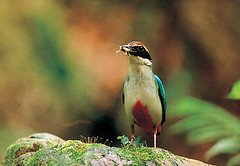
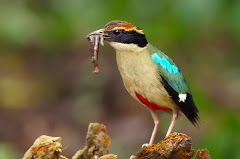
 Huben Fairy Pitta: courtesy of Richard Yu
Happy New Year,
and all the best for 2008 !
"Because every green measure, every conservation effort and all the little economies we could make in our daily lives, may look insignificant if we choose to look at the big picture. On the other hand, if we view that big picture as millions of little choices made by people just like us, that's how we can come to understand why it's our own choices that are so important."
A comment posted on Birdforum by James Owen.
Choices
"Because every green measure, every conservation effort and all the little economies we could make in our daily lives, may look insignificant if we choose to look at the big picture. On the other hand, if we view that big picture as millions of little choices made by people just like us, that's how we can come to understand why it's our own choices that are so important." A comment posted on Birdforum this morning by James Owen.
That was just what I really needed to hear this morning. Thanks, James ! It really puts the emission issue and conservation into a nutshell. It's all choices and how we go about our making choices is what it's all about.
2008 is all about choices. The choices that we make and how our choices will impact on our planet. Jame's comment was in a thread about a couple who are planning on a Big Year of birding. Jetting all over the world to try and notch up as many species as they can in a single year.
Big Years are trying to see as many species in a year as possible. Birders can do them locally, nationally and even internationally. Big Years aren't confined to birders only. It could be a Big year of cetaceans, mammals or even butterflies. The list is endless.
Birding Big Years can be very competitive and books such as Mark Obmascik's "The Big Year" will give one some insight into what a big Year is about. Big Years are what many birders dream about and I know I have. If we look at a Big Year, is it actually nothing more than vanity? Is it just selfless ambition? Well, I guess the choice is yours as to what to make of it.
I also came across this thread on Birdforum this morning, Doing a Bigby - Local Birding 2008, The Big Green Big Year. That sounded pretty good. A Green Big Year ! Doing it on foot locally or under your own steam on a bicycle, canoe or such like. Well, that sounded fun and I need the exercise so I signed up for that one. My Big Green Year in the Huben/Hushan IBA on pedal power.
Well back to choices. In today's Taipei Times the EPA calls on public to celebrate New Year's Eve with environment in mind. Your choice on letting off fireworks tonight and filling the neighbourhood with potassium, aluminum, magnesium, barium, lead, strontium, calcium, sodium, iron and zinc.... and scaring the hell out of the animals in the area.
Also, if you haven't voiced your concern to the Taiwan authorities over the Hushan Dam and the Taiwan pink dolphins, well, that's your choice. Letters helped to create the pressure needed to get the dolphins included in the environmental impact assessment process earlier this year. So often I hear people say we've got our own problems and we need to look at our home issues first. Fair enough, just remember the chances are that many if not all of the components in the computer you're using to read this now where made in Taiwan.
All the best for a Greener 2008 !
Sunday, December 30, 2007
Power firms sign emissions pact
On Friday ten private and public power companies signed voluntary agreements with the government to reduce carbon dioxide emissions by 12 million tonnes by 2015. Hopefully this is a sign of better things to come. Environmentalists have expressed concerns and understandably so. Taiwan hasn't really shown a desire to cut back emissions to early to mid 1990s levels at all. Talk has focused around 2005 levels and at best the 2000 level. For a country with a per capita emissions rate of three times the world average these proposals by the government and industry just don't make the grade and this isolationist type of thinking poses a real risk of internationally isolating Taiwan further as an emissions bandit as the nations of the world try and clean up.
Taiwan is developing industry that is going to increase the nation's CO2 emissions. Saying that a planned coal power plant that is going to be built was going to use 'technology a' and now it will be built using 'technology b' and that will save 'X' in emissions doesn't get around the fact that the coal power plant is going to be built and it is going to increase emissions.
A real effort to reduce power consumption needs to be made. A change in the nature of future planned industries needs to be considered and the need to change to more environmentally friendly and responsible industry needs to become the focus. Hushan Dam, Dadu Weir, more power plants, steel mills, and plastic plants are not the responsible way forward. Dressing up development that is going to increase greenhouse gas emissions is just greenwashing and sooner or later it will be exposed for what it is.
Also see: MOEA says emissions reduced at 4 local power plants
Thursday, December 27, 2007
Dadu Weir Project Public Explanation Meeting Report
 Taiwan Academy of Ecology protesting before the meeting over the diversion of water resources for industry, including private enterprises, by the water resources agencies and endangering the livelihoods of the Taiwanese people and the survival of the humpback dolphins.
Water resources official calls Dadu River without a dam “a waste”
On Thursday 20 December a meeting was held in the Town Hall of Hemei Township, Changhua County, to allow concerned parties to hear about why the Dadu River should be dammed and over a fifth of its water diverted for industrial use in Changbin Industrial Park and Yunlin Offshore Industrial Park. Repeat meetings were held that afternoon in Changbin Industrial Park Service Centre and the following morning in Dacheng Township.
The Dadu River (= Wu River) is the sixth largest river in Taiwan’s and a major source of fresh water for Taiwan’s west coast ecosystems. It feeds the Dadu Wetlands, which were previously listed by the World Conservation Union (IUCN) as being one of Asia’s four major wetlands*. In addition, the Eastern Taiwan Strait (ETS) Humpback Dolphins (Sousa chinensis), which occur in the shallow coastal waters along the west coast of Taiwan from the Tongsiao River estuary in Miaoli County to Taisi in Yunlin County, have been sighted in the Dadu River estuary. Reduced freshwater flow into estuaries such as Dadu was identified at the 2nd ETS Indo-Pacific Humpback Dolphin workshop in September this year as being one of five major threats to the population. Any diversion or impoundment of rivers flowing out to the west coast could, therefore, increase the level of threat of extinction of the population.
At this stage of the planning process, what was presented to the public at the meetings on the 20th and 21st was what is called the “Dadu Weir Feasibility Plan.” Projects subject to Environmental Impact Assessment (EIA) are presented to the public and to official review bodies in various forms, including “feasibility plans” such as this, and “Environmental Statements” (ESs) such as those presented to the EPA’s EIA Review Commission. Although the system has the potential to allow all parties to be fully informed of the costs and benefits of a project, it is frequently the case that variation in the sets of documents prepared for review by (and made available to) different stakeholders means that the whole picture is never presented, thereby limiting public participation and the effectiveness of the review process.
On Thursday, in addition to presentations by representatives from Sinotech Engineering Consultants Ltd. and the Central Region Water Resources Office , a simple flier containing maps, photos and a basic explanation of the purpose and advantages of the project was provided to interested members of the public, along with a blank comment sheet. The Public Explanation Meeting and the comment sheet are formalities required by Taiwan’s EIA regulations. Comments provided by the public are supposed to be included in further reports and considered in the further planning stages.
The meeting began with a broad explanation of the project. This included technical aspects, financial costs, benefits to society, the project timescale, compensation for land acquisition, flood control, environmental impacts, funds for environmental enhancement, dust-reduction strategies and prevention of burst pipes. As is customary, vital details were missed out, but members of the audience supplemented much of what had been left out or prompted the presenters for more information.
According to Sinotech, preparatory work, construction and operation tests will span a period of six years from January 2009 to December 2014 and involve an estimated cost to the public of NTD 26.8 billion (USD 824 million). The project is designed to meet the future needs of central western Taiwan’s Changbin and Yunlin Industrial Parks. However, as pointed out by the head of the Central Region Water Resources Office Mr. Jiang Ming-lang (江明郎), it only seems as if the project is targeted towards providing for industry. In actual fact, he said, “if we can satisfy industrial water needs, industry will not need to extract ground water. If they don’t extract ground water, they won’t need to compete with the people [for water resources]. So in the end, although the recipient is industry and not the public, and although it looks like this has nothing to do with the public, industry will no longer need to extract groundwater and so the people will benefit and industry can continue to develop.”
However, as pointed out a member of the audience during the question and answer session, if the water is to be used to meet the expanding future needs of industry for greater water supplies, it will not replace an existing source of industrial water (e.g. ground water) but will rather constitute an additional source of industrial water, doing nothing to address the continuing conflict between water resource users.
Arguments that river impoundment will help mitigate water resource disputes, land subsidence and saltwater intrusion have been used to promote other projects such as the Hushan Dam in Yunlin County (currently under construction), which is also designed to supply water for further development of Yunlin Offshore Industrial Park and hence faces similar criticism. A major concern is that agriculture will lose out to industry as more water is channeled directly to the industrial parks, depleting groundwater resources and failing to produce the glowing win-win results consistently promised by proponents.
Concerns were also raised by members of the public about potential impacts of the river diversion on the Dadu Estuary Wildlife Refuge. Sinotech claimed that impacts on the Refuge have already been minimized by setting the route of the water pipes along the path of an existing road. Also, because the water level would be raised rather than water being directly extracted from the river as happens in some river diversion projects, impacts on the environment would be “minimized”.
However, a deeper concern of many in the audience was the impact of reduced freshwater flow to the estuary. If the plan goes ahead, an estimated daily volume of eight hundred thousand tons of water will be diverted for industrial use, with around six hundred thousand of that being piped south to Yunlin Offshore Industrial Park. The Sinotech speaker said that after extraction there would still be nearly three million tons per day of water flowing to the estuary, which was “a lot” and therefore the removal of eight hundred thousand tons of water per day would “not impact on downstream reaches”.
If Sinotech’s figures are taken to be correct, however, 8 hundred thousand tons makes up over a fifth of the river’s flow. Several members of the audience expressed concern that little or no explanation was being provided as to how the developers had come to the conclusion that the Refuge would not be negatively impacted by this substantial loss of fresh water input.
As for the ETS humpback dolphins, the developers steered clear of the issue in their presentations, and it was once again members of the Matsu’s Fish Conservation Union (MFCU) who raised it. Indeed, the message that resounded after the presentations was that delivered repeatedly and passionately by Mr. Jiang – that leaving the Dadu River without a dam (making it the only major river in the central region without one) would be a “waste”. Of course it is true that all that “extra” water could be flowing into a petrochemical factory or a steel plant to be heated up and contaminated, rather than directly to the sea. However, this overlooks the innumerable uses to which the plants and animals of the west coast are already putting that water - if the river is indeed incomplete without a dam, one wonders what the Dadu River estuary will be without its fish, birds and humpback dolphins.
Notes:
Due to the efforts first of FormosaCetus and then other members of the Matsu’s Fish Conservation Union (MFCU), Environmental Impact Assessment (EIA) proceedings started to include some consideration of the dolphins in 2005. Now, while the Environmental Statement (ESs) produced for some projects might not mention the existence of the population, participation by the MFCU in EIA meetings has led to subsequent versions of some ESs including a paragraph or two on what is known about the dolphins’ distribution. However, these ESs do not generally address the likely impacts on the population, nor do they include the dolphins in any monitoring plans or mitigation strategies.
* Taiwanese official documents claim that Dadu was listed by the IUCN as one of Asia's four major wetlands. We have asked the IUCN to confirm this but no response has been received to date.
Links:
Dadu Weir Public Explanation Meetings
Wednesday, December 26, 2007
Bali climate talks nearly melt down
Another emissions related article appearing in the Taiwan papers today.
See: Bali climate talks nearly melt down in today's China Post.
Government to reduce CO2 emissions in Taiwan to 2000 levels
 The world's dirtiest power plant. Wuchi Power Plant, Taichung, through the haze.
The Government says it will reduce CO2 emissions in Taiwan to 2000 levels but is this enough? According to the Cabinet's chief technology adviser, Lee Yuan-tseh, the government will seek to reduce the annual carbon dioxide (CO2) emissions in Taiwan to year 2000 levels by 2025. This means that the government needs to cut current greenhouse gas emissions by approximately 40 percent.
The desire to reduce CO2 levels is good and we applaud that. However, the Taiwan government and EPA haven't exactly got a good track record when it comes to reducing emissions so naturally environmentalists remain sceptical. It's really time for the government and its agencies like the EPA to put the money where their mouth is and do something to demonstrate their sincerity in reducing emissions.
In 1998, the National Energy Conference reached a temporary agreement under which the government would aim to reduce CO2 emissions in the country to year 2000 levels by 2020. This clearly hasn't been happening nor has there ever been a serious effort to do so. Taiwan has the single largest CO2 emitting power plant on the planet. Taiwan's per capita CO2 emissions are three times the world average. We've watched controversial projects of dubious legality such as the Hushan Dam Project steamrolled through the EIA process. These projects are linked to the development of heavy-polluting industry on Taiwan's west coast. These are developments that will raise the country's alarmingly high emissions level even higher. Hushan Dam, a project that is trashing an internationally designated Important Bird Area (IBA) and destroying globally the most important breeding area for the Fairy Pitta is going ahead to meet the water demands of more planned heavy industry. The resulting reduction in the flow of freshwater into the Jhoushui River Estuary will have dire consequences for Taiwan's extremely vulnerable and unique population of humpback dolphin and will degrade critically important waterbird habitat in Dacheng Wetlands, another internationally designated IBA.
If the government is serious about reducing Taiwan's greenhouse gas levels then in the words of Cheng I-chin of the Taiwan Environmental Action Network (TEAN) "The government must reconsider building these monstrosities that would make us international outcasts in the fight against carbon emission reduction."
See Taiwan to push for reduction of CO2 emissions in the Taiwan News.
On a happier note. A more possitive story from today's Taipei Times:
EPA launches campaign to promote 'green hotels'
Tuesday, December 25, 2007

Bali conference allowed the world to go to work on the climate ?
See today's Taipei Times, Bali conference allowed the world to go to work on the climate.
Also in today's news the [Taiwan] Atomic Energy Council (AEC) says the Energy crisis could save first nuclear plant.
Monday, December 24, 2007
Emission coverage continues
As the Taiwan media continues its coverage of the CO2 emissions issue we'll continue to link to some of the articles because of their relevalce to both the Taiwan humpback dolphins and the Hushan Dam issues.
See 'Low carb' life can keep Taiwan cool and EPA selects 32 finalists in poster contest to promote carbon emission reductions in today's Taipei Times.
Saturday, December 22, 2007
EPA to unveil plan for global body next month
Environmental Protection Administration (EPA) Minister Winston Dang says the EPA will present a comprehensive plan next month to push for the establishment of a World Environment Organization (WEO). See today's Taipei Times for details.
Friday, December 21, 2007
Australia's first Fairy Pitta and a winter sighting on Borneo
Wintering records for the Fairy Pitta remain few and far between. It is generally suggested that the species most likely winters on Borneo but in reality researchers know little and most will admit to this being more of an educated guess.
Interestingly, a Fairy Pitta recently showed up in northern Australia. The bird was thought to be a Blue-winged Pitta at one point but has since been confirmed to indeed be Australia's first Fairy Pitta. Blue-winged Pitta are recorded as a vagrant to NW Australia. Click here, here and here for some photos and here and here for some info.
Also, a Fairy Pitta was photographed by a person named Yeo on Borneo at the Matang Wildlife Centre, Kubah National Park of Sarawak, Eastern Malaysia on 11 November 2007. We have seen two photos and the bird is a Fairy Pitta but we are still awaiting further details of the sighting.
See:
Fairy Pitta wintering area mystery continues
Search for the Fairy Pitta wintering area
'Green' action cannot wait for US
See Taiwan Environmental Protection Union (TEPU) Chair, Gloria Hsu's letter, "'Green' action cannot wait for US" in today's Taipei Times. Gloria urges Taiwan not to drag it's feet on cutting emissions and says that waiting for the US isn't an excuse for Taiwan not to act.
Also see:
Left out of the UN, decisions are made for us
Lee urges candidates to address issue of emissions
Government urged to take action on emissions
Taiwan must abide by international rules on greenhouse gas emissions: EPA
Thursday, December 20, 2007
Emissions talk continues
 Hushan, globally the most important breeding area for the rare and vulnerable Fairy Pitta being destroyed to build a dam to supply water for more planned heavy pollution-generating industry in a country which has a per capita CO2 emissions rate three times the world average. The dam will also degrade the remaining habitat of the endangered Taiwan humpback dolphins by reducing the flow of freshwater into the Jhoushui Estuary.
Talk over Taiwan's CO2 emissions continues. From the standpoint that Taiwan needs to be a UN member to really reduce its emissions to Nobel laureate Lee Yuan-tseh urging presidential candidates to aim at stabilizing CO2 emissions by 2025 at the level it was at in 2000. Environmental Quality Protection Foundation Chairman Liu Ming-lung said he supports Lee's idea of stabilizing Taiwan's CO2 emissions at the 2000 level by 2025 but added that when setting goals to reduce carbon emissions, stricter targets are not necessarily good because it might result in negative economic growth.
According to Taiwan's Department of Health Taiwan was ranked 22nd in the world in terms of total CO2 emissions in 2005. That is unacceptable to the health of the people of Taiwan and all life that we share Taiwan with. On that reason alone something drastic should be done. Stabilizing Taiwan's CO2 emissions at 2000 levels isn't enough and using the UN card as an excuse to act doesn't help the people of Taiwan. The whole world needs to change and so does Taiwan. If we don't, then nature will change us. Do we really want to build more dams and factories to further pollute our environment, destroy our health and drive species like the Taiwan humpback dolphins and numerous others over the brink into extinction?
"Many of us wonder whether human beings, one of ten million or more species on earth, have the right to destroy such a large proportion of what are as far as we know our only living companions in the universe." Ed Wilson & Paul Erlich
See:
Left out of the UN, decisions are made for us
Lee urges candidates to address issue of emissions
Also see:
Government urged to take action on emissions
Taiwan must abide by international rules on greenhouse gas emissions: EPA
Wednesday, December 19, 2007
Government urged to take action on emissions

Another article urging Taiwan to take action on against its high level of CO2 emissions. See Government urged to take action on emissions in the Taiwan News. Taiwan's per capita CO2 emissions are the highest in Asia and at 12 metric tons of CO2 annually per person it's three times the global average of 4 tons per person. Recently Nature magazine named Taiwan's Wuchi power plant in Taichung as the world's highest CO2 emitting coal-fired power plant. Taiwan seems to be forging ahead with developing more heavy industry that will substantially raise the country's level of CO2 emissions. This development will also directly impact very negatively on Taiwan's unique and extremely vulnerable humpback dolphins and many other Red List species which include the Fairy Pitta of Hushan.
Also see Taiwan must abide by international rules on greenhouse gas emissions: EPA
Taiwan's Wuchi Power Plant - the world's dirtiest
Tuesday, December 18, 2007
Dadu Weir Public Explanation Meetings
 The Dadu River Estuary
The Central Region Water Resources Office of the Water Resources Agency will be holding three Public Explanation Meetings on the 20th and 21st December (see below) in the Changhua area for the feasibility/planning of the proposed Dadu Weir which would reduce the flow of freshwater into the Dadu (Tatu) estuary. The "Matsu's Fish Conservation Union" will be holding a protest to coincide with the Public Explanation Meetings to raise awareness of the negative impact that the Dadu Weir would have on the unique and extremely vulnerable Taiwan humpback dolphins by reducing the flow of freshwater into the Dadu estuary and how this project will supply water to further develop Taiwan's heavy industry in a country where the per capita CO2 emissions are the highest in Asia and no meaningful plan seems to exist to try and reduce these emission levels.
Developers notice:
"Dadu Weir Project Feasibility Plan” Local Public Explanation Meeting
1. Premise for the Meeting
The Wu River catchment has plentiful water resources and is the main source of water for the Central Region [of Taiwan]. However, because the downstream reaches are polluted by municipal waste the water is of poor quality and the rate of water resource use is low.
The Water Resources Agency of the Ministry of Economic Affairs once planned to build Guosing and Jianmin Reservoirs in the upstream reaches of the Wu River, neither of which went ahead because of many factors. After considering the critical nature of the water resources situation in the Changhua/Yunlin area and the needs of future industrial development, the Central Region Water Resources Office of the Water Resources Agency took precautions and devised the “Dadu Weir Feasibility Plan” [大度攔河堰可行性規劃] in order to use the Wu River resources effectively, suggesting that the priority be to develop Dadu Weir to provide 800 000 tons of water a day industrial use, 300 000 tons per day of which would be supplied to Changbin Industrial Park, with the remaining 500 000 tons per day and Jiji Weir on the Jhuoshuei River to be used together to supply industrial water to Yunlin Offshore Industrial Park.
The estimated cost for the “Dadu Feasibility Plan” project is about 26.8 billion New Taiwanese Dollars. It is planned that in 2009 and 2010 the project will be designed and land acquired, and estimated that in 2011 work will start, and that in 2014 it will be finished, providing sufficient water for industrial use. In addition to promoting industrial development, this can also reduce groundwater extraction, to alleviate the problem of continued ground subsidence.
2. Basis and Purpose for the Meeting
According to Article 10 Item 1 of the EPA’s Standards for Environmental Impact Assessment of Development Activities [開發行為環境影響評估作業準則], before a developer makes and delivers its Environmental Statement to the EPA for review, it must hold at meeting to allow the public to participate and express their opinions.
Venues
20.12.2007 10am: Hemei Township, main auditorium on the 4th floor of the town hall.
20.12.2007 2pm: Changbin Industrial Park Service Centre Briefing Room.
21.12.2007 10am Dacheng Township Town Hall 3rd floor Big Meeting Room.
Taiwan must abide by international rules on greenhouse gas emissions: EPA
 Wuchi Power Plant, Taichung. The world's greatest CO2 emittions coal power plant
In the wake of the Bali Conference Taiwan's Environmental Protection Administration (EPA) Deputy Minister Chang Feng-teng has said that the nation's most urgent environmental issue is to follow international guidelines on greenhouse gas emission controls. Is this just more empty words from the government or are they really going to do something this time?
Taiwan is arguably the third highest per capita CO2 emitter on the planet. With projects like the Hushan Dam going ahead and others like the Dadu weir (consultation to take place 19-20 December)set to follow in order to supply the water needs for more planned heavy pollution-generating industry one wonders how on earth Taiwan is going to be able to follow international guidelines on greenhouse gas emission controls? The recent track record of Taiwan's EPA doesn't inspire confidence that the EPA has any real commitment to reducing CO2 emissions.
In the words of Cheng I-chin of the Taiwan Environmental Action Netwok (TEAN)"The government must reconsider building these monstrosities that would make us international outcasts in the fight against carbon emission reduction."
See: Taiwan must abide by international rules on greenhouse gas emissions: EPA in today's Taipei Times.
Taiwan's Wuchi Power Plant - the world's dirtiest

Taiwan's coal power plant at Wuchi, Taichung being named by Nature magazine (Vol 450/15 November 2007, p 327:- Graphic detail Countries with highest CO2-emitting power sectors, Tonnes per year) as producing the largest amount of CO2 emissions of any power plant on the planet prompted a member of the environmental impact assessment commission that is reviewing a private power plant project in eastern Taiwan to write an article that appeared in the local press. Our heart goes out to those few commissioners of conscience who try and raise the real issues while participating in the window dressing exercises of Taiwan's Environmental Protection Agency/Developer/Elected Representative clique. We have created an incredible nearly unstoppable pollution generation monster through a simple, three-step process:
1) Privatize energy generation, but keep distribution with the state-owned Taiwan Power Company
2) Taiwan Power is legally required to buy all energy generated, regardless of need
3) Keep the people in the dark as to where the money and energy are going and as to the true costs
Sixty years of isolation under the Chinese KMT rule and for the last eight years under the Taiwanese DPP rule, are taking their toll.
See: CO2 for Taiwan pollution forever
Also see:
Taiwan Power Plant Tops in Carbon Output, Group Says
Monday, December 17, 2007
The environment must come first
As the world's eyes have been on Bali, take a moment to consider that Taiwan isn't there. Consider that Taiwan ranks amongst the highest per capita CO2 emitters on the planet but the world's not talking to them. See the Taipei Times's editorial "The environment must come first."
More animal rights or just more talk?
On Friday the legislature overhauled the Animal Protection Act. This is indeed a good step in the right direction but given that Taiwan's previous legislation on animal protection wasn't that lax one asks if this was just another case of window dressing. The real test will be to see if it gets enforced. While they're talking about animal protection how about something more for Taiwan's pittas and pink dolphins?
See: Lawmakers pass overhaul of law on animal rights
The 17th Biennial Conference on the Biology of Marine Mammals

We've just returned from the 17th Biennial Conference on the Biology of Marine Mammals held in Cape Town, South Africa. The conference offered on opportunity to help raise international awareness of the plight of the Taiwan humpback dolphins and other related Taiwan issues like the Hushan Dam project. We'll be posting more on the conference shortly.
See, Cape Argus: Loss of 'goddess' a grave warning sign
Sunday, November 25, 2007
Taiwan's Humpback Dolphins make it into India's Central Chronicle
An Indian daily newspaper, Central Chronicle, recently ran an article titled Rare dolphin faces extinction on the plight of the Taiwan humpback dolphins. Great to see the issue making the papers in other Asian countries.
The Taiwan humpback dolphins will face further habitat loss with the Hushan Dam reducing the flow of fresh water into the Jhoushuei estuary.
Monday, November 19, 2007
Formosa Plastic Group's Yunlin Steel Mill Needs More Review
 The FPG plant at Mailiao, Yunlin
See former Environmental Impact Assessment Committee member Lee Ken-cheng's article titled Formosa Plastic Group's Yunlin Steel Mill Needs More Review for some further insight into the Mailiao and Hushan Dam development issues.
Taking the plight of the Taiwan humpback dolphins abroad - The 17th Biennial Conference on the Biology of Marine Mammals
 View of Cape Town, host city to the 17th Biennial Conference on the Biology of Marine Mammals
The unique population of Taiwan humpback dolphins face many threats, amongst these is more industrial development on Taiwan's west coast that will destroy habitat critical to the survival of this species. The Hushan Dam will supply water to these developments. In addition to the development that will result in the destruction of prime dolphin habitat the Hushan Dam will also reduce the flow of fresh water into the Jhoushui estuary which will further degrade this important wetland environment which is critically important to the survival of these unique dolphins and other marine life.
The Society for Marine Mammalogy will be holding the 17th Biennial Conference on the Biology of Marine Mammals from 29 November to 3 December, 2007, in Cape Town, South Africa. Matsu's Fish Conservation Union members will be present. Wild at Heart Legal Defense Association, will have a booth at the conference. Also, FormosaCetus Research and Conservation Group will be doing two presentations on the Taiwan humpback dolphins. In addition to this the steering committee that was established at the Second International Workshop on the Conservation and Research Needs of the Indo-Pacific Humpback Dolphins, Sousa chinensis, in the waters of western Taiwan will be meeting to work on the establishment of an international working group of scientific experts whose mandate will be to provide independent advice on ETS humpback dolphin research and conservation.
Friday, November 16, 2007
Kaohsiung's air gets worse
A short piece from yesterday's Taipei Time's Taiwan Quick Take section. See Kaohsiung's air gets worse. The recent poor air quality in the Kaohsiung area largely blamed on existing west coast industry....and the government and developers are planning more.
Monday, November 12, 2007
EPA and supporters celebrate 9th year of green lifestyle
 Farmer burning waste
The headline EPA and supporters celebrate 9th year of green lifestyle in today's Taipei Times caught my eye. I had a look and read how the Environmental Protection Administration (EPA) and thousands of environmental volunteers in a number of cities and counties yesterday celebrated the EPA's ninth year of its Low-carbon Lifestyle Program.
While I'm all for programs and efforts to reduce carbon levels and applaud and encourage any such effort I couldn't help thinking that this was just another green-washing type drive to lay a smoke screen over the EPA's reluctance to really make a concerted effort to do something concrete to address the issue of Taiwan's carbon emissions problem.
I dread October and November each year because I know that that is the time that countless farmers burn their fields and every piece of garbage and unwanted vegetation they can rake together. For about eight weeks my nose constantly runs, I cough and get headaches. The washing smells like a bonfire and the house gets full of ash. I can't see the buildings just a few hundred meters down the road. I wonder if I'm the only one in Taiwan that feels this way? Why should we put up with this? Burning trash is illegal! This happens openly and what do the authorities do? Nothing, it would seem !
I mentioned this to a friend living in another county. He said that perhaps it was only a problem in my area. I replied saying I didn't think so. In the weeks that followed I travelled the length of the country from Taipei to Kenting. And from the train and bus window I could see fire after fire after fire for weeks on end stretching from north to south along the western coastal plain. I wonder how much carbon is emitted from the this uncontrolled burning? We haven't even got to the factories, and the cars.
The EPA seems set on trying to help pass projects like the Hushan Reservoir to get those west coast development projects off the ground. Sure, money will be made in the short-term but what about the environment and all of creation that has to live, eat, drink and breath the pollution? How much will we have to pay to clean up the mess we are making for a quick buck?
Come on EPA. Let's get real and really do something about Taiwan's carbon emissions and do your bit in creating a real Low-carbon Lifestyle program for all of Taiwan. 
Taipower through the haze, Wuchi, Taichung
Tuesday, November 6, 2007
Green Party Taiwan to enter the legislative elections
The Green Party Taiwan (GPT) announced yesterday that it has named five candidates for January's legislative elections.
See today's Taipei Times for the story.
The 2007 Taipei Birdfair
 Wild at Heart stand
The annual Taipei Birdfair took place over the weekend in Guandu, Taipei. The event was hosted by the Wild Bird Society of Taipei. Taiwan's various bird societies were well represented. Other organisations and groups were also present. These included Wild at Heart Legal Defense Association, Taiwan Endemic Species Research Institute, and Shei-Pa National Park amongst others.  2007 Taipei Birdfair
Several foreign birding groups and NGOs were also present. These included the Wild Bird Club of the Philippines; Chengdu Bird Watching Society, China; Hong Kong Bird Watching Society; Wild Bird Society of Japan; Tourism & Wildlife Society of India; BOCA, Australia; Bird Conservation Society of Thailand; and The Ocean Conservancy, California, USA.
Wild at Heart Legal Defense Association and the Wild Bird Society of Yunlin, both members of the Taiwan National Coalition against the Hushan Dam and Matsu's Fish Conservation Union, had stands presenting the Hushan Dam - Fairy Pitta issue as well as the plight of the Taiwan humpback dolphins. Wild Bird Society of Yunlin stand.
Friday, November 2, 2007
Taipei Birdfair
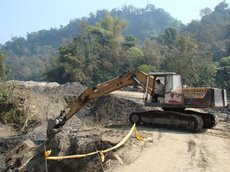
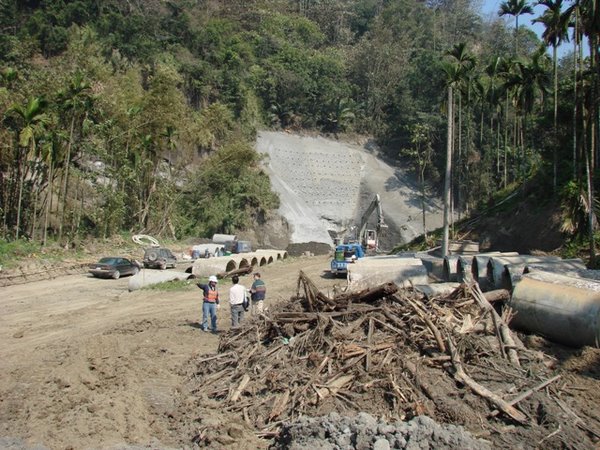
 Hushan Dam construction site
If you're in the Taipei area this weekend (3-4 November, 08:00-17:00) Wild at Heart Legal Defense Association and the Wild Bird Society of Yunlin will be at the 2007 Taipei Birdfair in the Guandu Nature Park* telling visitors about the Hushan Dam issue, the Taiwan humpback dolphins, and other environmental issues.
*There will be shuttle buses running from the Guandu MRT Station. There will also be stands at the Zhishan Cultural and Ecological Garden but the main events will be at Guandu.

 Posts
Posts