On Wednesday, September 24Th, the first hearing on the citizen's suit against the Environmental Protection Administration (EPA) was held -- nearly a year and a half after our first letter! So much for justice.
The application for an injunction had earlier been refused. There was an appeal and on August 29 the Supreme Administrative Court remanded the case for further review. A hearing date has yet to be set by the High Administrative Court which is a little strange given the urgency of injunctions.
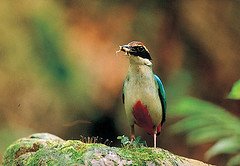
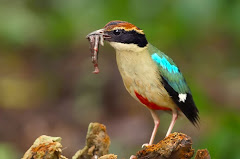
At the September 24Th hearing ten groups opposing the dam were represented by George Chen and Sanjia Lin, and the EPA had a lawyer. The hour hearing focused mostly on claims that the EPA's permission for the construction was flawed and that the EPA should cancel the permission based on illegality or in the alternative on the grounds that circumstances have changed (e.g., discovery of the Fairy Pitta's important breeding grounds, 921 earthquake induced geologic changes, and climate change.).
Overall the claim is that the EPA neglected its duty to order the work to stop on the dam -- a project we assert is proceeding illegally -- and that the major violations of the terms of the environmental impact assessment are such that they constitute "major flaws" for purposes of article 23 of the EIA Act and that the EPA therefore has the authority to shut down the project.
Interestingly the EPA's lawyer spent most of the time defending the EPA by saying things like "The EPA has been doing a good job, really it has. We have already fined the developer, the Central Water Resources Agency, twice for their misbehavior".
While it may be very difficult to stop the dam at this point, this action is helping to make a record and also perhaps demonstrate that these agencies can't be so cavalier in the future.
The next hearing on the merits is on October 22ND, 2008.
Monday, September 29, 2008
Hushan Dam Update: - The citizen's suit against the EPA

Some recent photos of the Hushan area
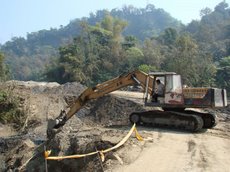
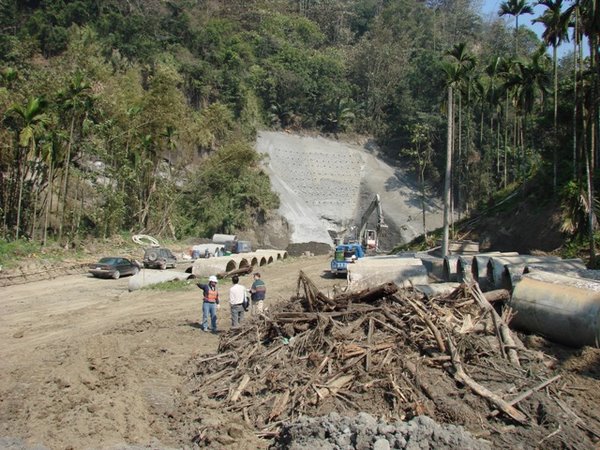
Taiwan is also known as Typhoon Island. Our fourth typhoon of the season has just passed over the island. Typhoons bring heavy rain and strong winds. Landslides are common and bridges get washed away on occasions. During construction of the dam large areas of deforested land lay open to the elements to erode silting up rivers as valuable top soil washes away.
While undoubtedly the construction crews try to minimise this erosion because it causes delays for them, they are pretty powerless against the mighty forces of a typhoon.
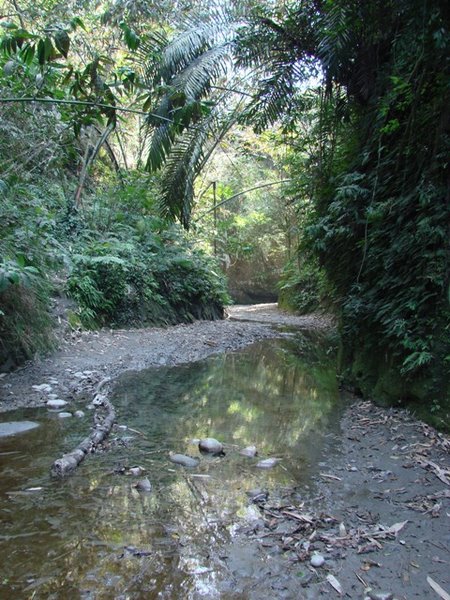
Some recent photos of the Hushan area follow showing construction work and some of the damage caused by recent typhoons. Who knows what damage has been caused during the present typhoon? Looking at some of the damage to the bridge and construction work once again highlights the question many have long been asking. Will this dam really be able to stand up to Taiwan's frequent typhoons and earthquakes? Is this not all just a real waste of a very important environmental area?


All photos courtesy of C.C.Chen
Thursday, September 11, 2008
Why are we building dams for new power plants ?
 The world's dirtiest ! Wuchi Power Plant through the haze (Taichung).
Read the article titled, Emissions policy doesn't add up from today's Taipei Times and then ask yourself the question, Why are we building dams for new power plants ?
Destroying valuable natural areas like Hushan, part of an internationally recognised important bird area (IBA), so new dams can supply huge quantities of water to new and upgraded power plants, and the new heavy industry that those power plants are supplying power to, and in the process increase emissions by up to 40% and at the same time wreck large areas of coastal habitat through reclamation projects and pollution which will likely result in the extinction of the critically endangered population of Taiwan humpback dolphin when we are trying to reduce emission levels because of the very real threat of global warming just seems insane. Wow! What a mouthful. Well, you get the point. Read the article, ask the question, and if you figure out the logic in this, please let us know.
Also see:
Planting trees a PR ploy
Tuesday, September 9, 2008
Japanese Paradise Flycatcher seen in Hushan
 Japanese Paradise Flycatcher: courtesy of Richard Yu.
 Forests being cleared for the Hushan Dam
Ten days ago a Japanese Paradise Flycatcher (Terpsiphone atrocaudata) was recorded in the Huben/Hushan Important Bird Area (IBA) by researchers. The Japanese Paradise Flycatcher is very rare in Taiwan and this is the first record from the area. The Japanese Paradise Flycatcher is listed as Near Threatened on the IUCN Red Data List. This is just another reason why this important natural area needs to be protected not destroyed!
An updated bird list for the area will be issued shortly.
Update: Orange-flanked Bush Robin: A new bird species for Hushan; and resightings of the Japanese Flycatcher.
Tuesday, August 19, 2008
Being the change we want to see in the world: Robin Winkler Interview
Today's Taipei Times carries an interview with Robin Winkler, founding director of Wild at Heart Legal Defense Association. Robin has been a long-serving Taiwan-based environmentalist and Wild is secretariat for the Matsu's Fish Conservation Union and a member of the Taiwan National Coalition Against the Hushan Dam.
Click Being the change we want to see in the world to read the interview.
Thursday, August 14, 2008
Critically Endangered - It's Official !

Yes, it's official! The Eastern Taiwan Strait population of humpback dolphin has been officially classified as Critically Endangered (CR) on the Cetacean update of the 2008 IUCN Red List of Threatened Species. The International Union for Conservation of Nature (IUCN) has recognised the overwhelming threat to these animals and have classified them as Critically Endangered, the highest category of threat-level on the Red List for wild animals before becoming extinct.
What this means is that unless drastic steps are taken to protect this species, they will go extinct. The reduced flow of freshwater into the humpback dolphins estuarine habitat resulting from the Hushan Dam Project is seen as a major threat to these unique dolphins.
The IUCN refers to the Taiwan humpback dolphins as the Eastern Taiwan Strait humpback dolphin Sousa chinensis and classifies them as a sub-population.
There can be no doubt now over the threat these dolphins face and the need for something drastic to be done to save these unique animals and pull them back from the brink of extinction. The time has come for the Taiwan government to stop dodging the issue of meaningfully protecting these dolphins and to do something concrete to save them. The writing is on the wall now and any failure of the authorities to act will be nothing short of signing the death warrant of this unique population of Taiwanese dolphin.
Our appreciation to the Cetacean Specialist Group of the IUCN Species Survival Commission for their work in this and our thanks to all at the MFCU and our supporters who have helped bring this about both here in Taiwan and abroad. We eagerly await the government's response to this and trust that they will make a genuine meaningful effort in saving these unique and rare citizens of Taiwan.
Also see:
Press Release: Taiwan’s unique population of Indo-Pacific humpback dolphins is on the brink of extinction
Matsu’s Fish seizes “Critically Endangered” title, winning international glory for Taiwan
Wednesday, July 30, 2008
Summer Dolphin Observation & Surveys - volunteers needed
 Photo courtesy of Wild at Heart Legal Defense Association.
August marks the beginning of this summer's sea-based humpback dolphin surveys. Within days, MFCU partner, FormosaCetus Research and Conservation Group, will start this season's sea-based surveys. Other members of MFCU will be conducting land-based surveys and observation in support of the sea-based effort. Volunteers are needed to help with conducting land-based surveys and observation on the central-west coast. If you are interested in volunteering (previous experience isn't a prerequisite as training will be given) for land-based surveys and observation please contact us at: "keephushanwild@gmail.com"  Photo courtesy of FormosaCetus Research & Conservation Group.
 Photo courtesy of Wild at Heart Legal Defense Association.
Tuesday, July 29, 2008
River Dust
 A dusty floodplain in the Jhoushui River - Chingshui River confluence area
The problem of river dust has been an ongoing problem in Taiwan. The floodplains of the Jhoushui and Chingshui Rivers in western Taiwan have been particularly bad. Taiwan's rivers are by nature short with a very steep gradient. The westerly-flowing rivers, with their source in the central mountains, with many peaks higher than 3000m, descend rapidly onto the western coastal plain. During typhoons these rivers carry great volumes of water and thus are characterised by a very wide lowland floodplain. This, to a point, naturally creates river dust during the November to December and February to March dry seasons.
In more recent times, with the damming of rivers higher up, the volume of water in rivers on the coastal plains has decreased considerably. This has drastically increased the river dust problem in West Taiwan. With industry demanding more water the problem has increased. To meet the demands of industry the authorities turned to pumping groundwater. This has further aggravated the river dust problem. While the EPA reports some progress in the battle against river dust, we can only expect the problem to increase when water from the Chingshui River is diverted to the Hushan Dam further reducing the volume of water in the lower reaches of the Jhoushui and Chingshui Rivers.
Not only does the reduced volume of fresh water flowing into coastal estuaries create a dust problem, it also has a very negative impact on the coastal ecosystems that depend on it resulting in the degradation of coastal habitat. Probably the most prominent victim of degraded coastal habitat is the unique Taiwan population of humpback dolphins where numbers have declined to around seventy individuals and will certainly become extinct unless drastic measures for their protection are taken now. The EPA needs to seriously consider the implications of the total degradation of the west coast and what that would mean. Is it really within our best interests to sacrifice the west coast for the short term gains of increasing pollution-generating, high water-volume-consuming heavy industry in the area?
EPA reports progress in battle against river dust
Also see:
Air quality worsens from Typhoon Morakot's dust
Thursday, July 24, 2008
EPA postpones ruling on Yunlin Sixth Naphtha Cracker plant expansion
Expansion plans for the Sixth Naphtha Cracker in Mailiao Township, Yunlin County underwent a fourth review by the Environmental Protection Administration's (EPA) Environmental Impact Assessment (EIA) Committee yesterday. The EIA Committee requested additional information from the Formosa Plastics Group before it could rule on expansion plans for an Yunlin County plant. The expansion of the Sixth Naphtha Cracker poses a threat to the extremely vulnerable unique population humpback dolphins that inhabit the West-Central Taiwan coast. The controversial Hushan Dam is being constructed at great expense to Taiwan's natural environment to supply water for the development of heavy pollution-generating industry on the west coast.
See today's Taipei Times for the story.
Saturday, July 12, 2008
Video Footage of Taiwan's Humpback Dolphins - Right In Front Of Formosa Plastics!
The construction of the Hushan Dam has largely been for the benefit of industry and the further development of Taiwan's already industrialised West Coast, home to the extremely vulnerable rare Taiwan humpback dolphins. Two great film clips of Taiwan humpback dolphins right in front of Formosa Plastics have been posted on MFCU member Wild at Heart Legal Defense Association's website. Clearly visible in the background is Formosa Plastics Mailiao Industrial Park in Yunlin County - where proponents of further development have denied the presence of these dolphins. Thanks to the work of MFCU member FormosaCetus, we are able to disprove such claims and give this population a better hope of survival.
View Taiwan humpback dolphin film clips.
Other Taiwan humpback dolphin film clips:
July 2008 Taichung Port.
January 2008 Wuchi.
UK Birder visits Huben
UK birder, Ann Chaplin, a long-time supporter of Fairy Pitta conservation in Taiwan and opponent of the Hushan Dam project visited the Huben-Hushan area during June. A brief trip report of her Taiwan trip can be found on Birdforum.
Friday, June 13, 2008
Taiwan: A Birder's Paradise
Singaporean birder, Low Bing Wen Albert, has posted a Taiwan trip report on Surfbirds titled Taiwan: A Birder's Paradise. Albert spent a week in the Huben/Hushan IBA area during his Taiwan trip.
See Birding in Taiwan's Yunlin County for more Taiwan Trip Reports.
Friday, June 6, 2008
Tough times call for tough measures
Yesterday the Presidential Office announced a so-called energy-saving program. Today's Taipei Times editorial titled Tough times call for tough measures offers some comment on the government's energy stand.
President announces energy-saving program
Also see: Nuclear power listed as energy option
Wednesday, June 4, 2008
Planting trees in China and other sorry tales

 And the trees are gone! Two shots of the Hushan Dam site after the forest had been cleared-May 2008.
The government could allow industries to plant trees in China and other countries to help reduce greenhouse gases blamed for global warming, an official said yesterday. Well, so claims today's Taipei Times. The article says, "Companies say they cannot find enough land locally to plant trees to offset carbon dioxide emissions, so they hope to plant trees overseas." The reality of the situation is that we are producing more CO2 than any tree-planting campaign can hope to deal with (See: Planting trees to off-set emissions isn't going to do it). These gimmick-type ideas are not going to help. This type of thinking just highlights that industry and the powers that be in Taiwan just refuse to get it. The reality is we need trees. Trees are not going to save us from our CO2 mess. Only a change in how we live is going to do that.
Right now we are cutting down forests in Hushan to build a dam for heavy industry. Industry that will increase our CO2 emissions. In Mailiao they are "reclaiming land" that is valuable humpback dolphin habitat to plant trees in the ocean to offset emissions. Something is wrong with this kind of thinking. This kind of "solution" is seriously flawed. It shows that we in Taiwan are not seriously tackling our emissions problem. We need our forests because they are a cornerstone of what allows are planet to function. Forests should not be see only as sponges for our emissions. In Taiwan vast areas of land under the Forestry Bureau are covered in exotic bamboos and other exotic plants and no attempt is being made to restore areas like this to native original-type vegetation.
Taiwan needs to seriously tackle its emissions problem. It needs to seriously reforest and restore areas in a genuine scientifically sound forest recovery and restoration program. It would seem that regardless of the EPA being Blue or Green it is still clinging to the ideal of everything but protecting the environment.  Reclaiming valuable humpback dolphin habitat to plant trees in the ocean.
 A chainsaw-wielding worker clearing vegetation in Hushan
Monday, May 26, 2008
Second Global Greens Congress
 Green Party Taiwan's Su-hsin Tsui addressing the Global Greens Congress on 3 May 2008 in São Paulo, Brazil on the future of the Global Greens: Taiwan’s Perspective, Taiwan’s Role
A 22-member Green Party Taiwan delegation recently returned to the island from the second congress of the Global Greens that was held May 1-5 in São Paulo, Brazil. The first Global Greens congress was held in Canberra, Australia, in 2001, and produced the Global Greens’ Charter, while the main document to come out of the São Paulo Conference was 21 Points for the 21st Century.
The Global Greens is an organization comprised of over 80 members from nearly as many countries with its administration being divided into four regional groups – Americas, Europe, Africa and Asia-Pacific. The most active members are Green political parties, but other civic organizations are members and the Global Greens seek to include all groups that subscribe to the core values of ecological wisdom, non violence, social justice, sustainability, respect for diversity and participatory democracy.
Five major topics discussed at the congress were sustainable cities, climate change, post-Kyoto, future of the Global Greens, and biofuels versus biodiversity. In addition to adopting the 21 Points, the congress passed resolutions supporting the peoples’ struggle in Tibet, ban on nuclear power as a response to climate change, and continued support for Ingrid Betancourt, the Colombian activist who was running for president on the Green Party ticket when abducted more than six years ago.
Upon their return to Taiwan, the delegation held a press conference on Monday, May 12, which was quite well received by the press.
Robin Winkler, founder and director of the Taiwan Wild at Heart Legal Defense Association, was active in the planning and execution of the visit. He broke his three- and a-half-year “boycott” of international travel to join the delegation. During a debriefing for Wild colleagues on 16 May 2008, he explained his recent involvement in the Green Party Taiwan:
“Being punched by the head of Yunlin County’s Assembly while the manager of Formosa Plastic’s local plant looked on and facing ridicule and jeers from the media, Taiwan’s EPA and other government agencies was one of the more traumatic experiences of my life. It forced me to reconsider the strategies of the environmental and social movements in the face of such an organized, well-funded and anarchic alliance of government, elected representatives, business and academics.
“World wide the movements face similar problems, however Taiwan differs in that we are very isolated from the rest of the world – not the world’s multinational corporations or trade and investment delegations, but from a vast resource of dedicated people and organizations that will no longer allow the world to go on “business as usual”. These groups have a lot to offer Taiwan, and with our connections to Green Parties around the world, we may actually be able to bring some pressure on business and government in Taiwan to reform its ways and to open up to public participation in important issues.”
Also see:
Update on the Global Greens Congress
Hushan Dam at the Global Greens Congress
Wednesday, May 21, 2008
Rearranging of the deckchairs on the "Taiwan-EPA-atanic" ?
Changing of the guard or just rearranging of the deckchairs on the "Taiwan-EPA-atanic" ? The new Environmental Protection Administration (EPA) Minister, Steven Shen, has vowed to work with outside groups claims the Taipei Times.
Yesterday saw the incoming President, President Ma Ying-jeou, sworn in and the return to power of the KMT. Last time round the KMT had a shocking environmental record and during the eight years of DPP rule not much seemed different in the EPA's attitude.
Outgoing EPA Minister, Winston Dang, while painting a rosy picture of his term can't get away from the fact that he bitterly disappointed most environmental groups with the handling of the reelection of EPA Commissioners and the Hushan Dam project, and the greenwashing of the global warming and emissions issue.
Will there really be a change of heart in the EPA or will they continue with the tradition of business first over the environment?
Tuesday, May 13, 2008
Update on the Global Greens Congress
Earlier in the month we informed our readers that a Taiwan delegation would be attending the Global Greens Congress in São Paulo, Brazil. The Global Greens are the international network of Green parties. The Global Greens held their second international congress in São Paulo, Brazil from May 1st-4th.
Today's edition of the Taipei Times runs an article outlining the Taiwan delegation's involvement at the recent Global Greens Congress.
See: Groups emphasize "green diplomacy".
Also see:
Second Global Greens Congress
Monday, May 12, 2008
Korean Fairy Pitta researcher visits Huben
 Dr. Scott Lin of TESRI and Kim Eun Mi of the Jeju Wildlife Research Center measuring a Dusky Fulvetta.
South Korean Fairy Pitta researcher, Kim Eun Mi, of the Jeju Wildlife Research Center visited Huben as a guest of the Fairy Pitta Research Project headed by Dr. [Scott] Lin Reuy-shing from May 3rd-9th.
In February our colleagues at Wild at Heart Legal Defense Association sent two delegates to the Annual Jeju Wildlife Research Center Workshop on Jeju Island, South Korea. Korea's Jeju Island, along with Taiwan, Southern Japan, and Southern China are the breeding areas for the IUCN Red Listed Fairy Pitta Pitta nympha. Dr. R.S.Lin of the Taiwan Endemic Species Research Institute (TESRI) and Mark Wilkie of Wild at Heart Legal Defense Association delivered presentations on the Fairy Pitta in Taiwan.
Two of the goals of the trip were to establish cooperation on Fairy Pitta research between Korean and Taiwan researchers and to propose the use of standardised research methods for better comparison of regional data at an international level to help facilitate an international conservation plan. Following the Jeju Workshop, South Korean Fairy Pitta researcher, Kim Eun Mi, was invited to come and spend a week in Huben with Dr. Lin and his research team and to learn research methods and techniques used on Fairy Pitta in Taiwan.
Apart from spending time in the field and at TESRI, Kim delivered a presentation on Fairy Pitta research in Korea at the Fairy Pitta Cafe to the local people of Huben. She also made a brief visit to Tatachia, Yushan National Park with Lin and Wilkie.
Taiwan's Fairy Pitta arrive several weeks before Fairy Pitta arrive on Jeju Island, South Korea, in late May. This gave Kim the opportunity to work in the field with Taiwan's newly arrived Fairy Pitta before returning to Jeju for the start of the Korean Fairy Pitta breeding season. Kim will be incorporating some of Lin's research methods and techniques into her research this season to help standardise research methods for better comparison of regional data at an international level which will contribute to the establishment of an international conservation plan. A global Fairy Pitta census is critical to the formation of any international Fairy Pitta conservation plan. A Taiwan Fairy Pitta survey team is planing to visit Jeju in June 2009 to assist with a Fairy Pitta census of Jeju Island. To date, Taiwan is the only country within the Fairy Pitta breeding range to have conducted a complete national census. Plans for holding an international Fairy Pitta symposium in Jeju to coincide with the census are presently being discussed.
Also see:
Hushan's Fairy Pittas at the Jeju Wildlife Research Center Workshop in South Korea
The destruction continues
The destruction continues. Some recent photos taken of the Hushan Dam construction site.


Also see:
Hushan Dam site visit: Photos
Recent Images of Hushan
Friday, May 2, 2008
Hushan Dam at the Global Greens Congress
The Global Greens is the international network of Green parties and political movements. Global Greens are holding their second international congress in São Paulo, Brazil from May 1st-4th. Green Party Taiwan has sent a twenty-two member delegation to the congress. Amongst the Green Party Taiwan delegates is Wild at Heart Legal Defense Association director, Robin Winkler. Robin will be helping to spread the word internationally on the Hushan Dam and the plight of the Fairy Pittas and Taiwan humpback dolphins. Wild acts as the secretariat for the Taiwan National Coalition Against the Hushan Dam and Matsu's Fish Conservation Union.
Update
See: Global Greens Congress
Also see:
Second Global Greens Congress

 Posts