The Formosa Plastics Group proposed investing NT$706.8 billion (US$21.7 billion) in Taiwan over the next five years, yesterday. See today's Taipei Times for the story. Given the state of Taiwan's natural environment is this investment at all? What are the long term costs to Taiwan's environment and all who live here? It would seem that for now the glitter of gold blinds us to the growing typhoon on the horizon.
Saturday, October 13, 2007
Formosa spending again

Monday, October 8, 2007
More on the Environmental Impact Review Committee Meeting
 They say they're not there? A humpback dolphin in the inshore waters around the Formosa Plastics Plant at Mailiao, Yunlin County: Photo courtesy of FormosaCetus Research & Conservation Group.
The Taiwan EPA's Environmental Impact Assessment Commission held the 156th meeting on 1 October 2007. Two cases reviewed are of particular interest to those concerned with the Hushan Dam issue and the plight of the humpback dolphins living along the coast of western Taiwan. Namely, the coal fired power plant in Taichung next to the Wu (Dadu) River estuary, and the Formosa Steel Plant next to the Formosa Plastics Plant which abuts the Jhuoshui River estuary.
Although several commissioners questioned the power plant's viability in light of central Taiwan's already exceeding its emissions limit, the chair (Minister of the EPA, Winston Dang) quickly gave the project approval. The plant must still go through a competitive privatization procedure at the end of the year before it can be finalized. The Formosa Steel Plant had been recommended by the previous commission for a second phase evaluation, however, the EPA has announced that the commission chose to go against that recommendation and instead instructed the EIA department of the EPA to put together another subcommittee to review the case as part of the first phase process. Second phase EIA's are considered more stringent and require considerably more public participation. The developers claimed during the meeting that there are no humpback dolphins off the shore of Yunlin despite environmental groups having passed out posters to the commissioners showing dolphins against the background of Formosa's Yunlin petrochemical plant.
Also see:
Environmental Impact Review Committee Meeting
Formosa Steel Plant update
Wednesday, October 3, 2007
Environmental Impact Review Committee Meeting
On Monday October 1 the Environmental Protection Administration's (EPA) Environmental Impact Review Committee voted to form a special taskforce to review construction of a Formosa Plastics steel plant in Yunlin. This was overruled by the EPA Minister. We'll be giving more details as soon as they become available.
See Tuesday's Taipei Times's Review committee sparks ire.
Also see:
More on the Environmental Impact Review Committee Meeting
Formosa Steel Plant update
Formosa spending again
Tuesday, October 2, 2007
More water for Formosa means less for Taiwan
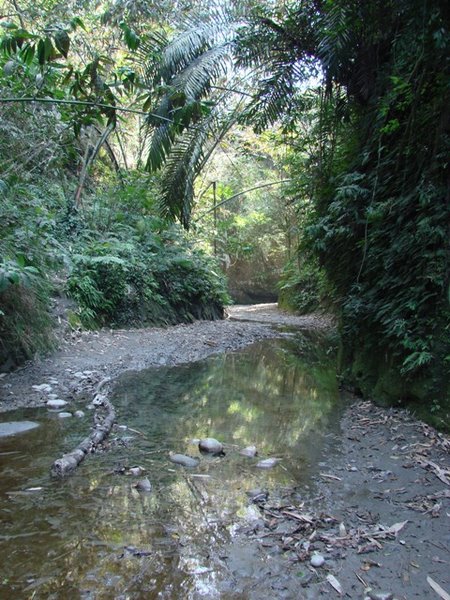
 The You-cing Valley as it was before the Hushan Project
According to a report buried on page 20 of the 29 September edition of the Apple Daily, a subcommittee was formed to review Formosa Plastic's application to increase its water allowance from 251,000 tonnes/day to 351,000 tonnes/day. The report continued that the head of the Overall Planning Department, Huang Guanghui, said that the decision of the subcommittee would have to be approved by the plenary commission, which at the soonest will be in mid October. The report appears to have been accurate except that the original approved amount was 257,000 tonnes/day.
Interestingly, this case involves a number of issues that were headline news earlier this year, including the public's right to information about violations by developers of environmental laws or commitments made pursuant to the approval of their environmental impact assessments, whether there is a legal basis for the application by Formosa for a change in the water usage - the original commitment was backed by a pledge from chairman of Formosa Plastics who said they would shut down operations to the extent necessary to meet their commitment to keep water use down, and how on the day after Formosa Plastics chairman's visit to President Chen, the Executive Yuan canceled an NT$7 million dollar fine against the company for violations of its EIA. Just how long are corporations going to be allowed to keep reporting incredible profits each time financial reports are due at the expense of the well being of the environment and ultimately all who live in Taiwan and generations to come?
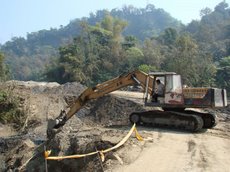
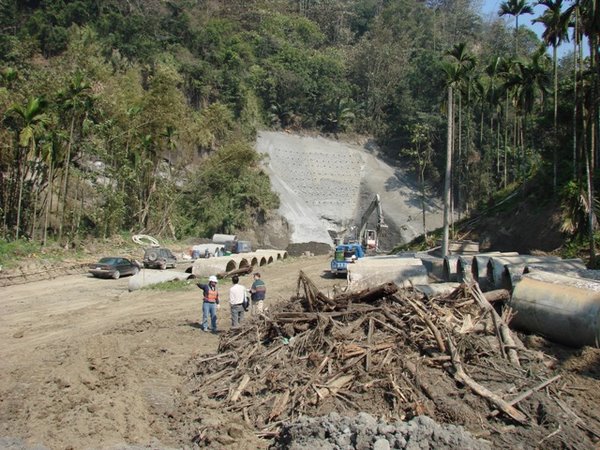
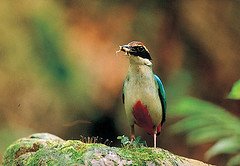
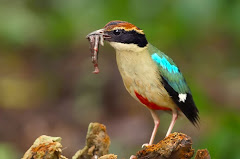
Well, it isn't surprising, when it is a choice between Wang Yongcing and Formosa Plastics need for cheap water and the marine life along the Yunlin coast: Taiwan's government continues to send the message that it wants our country to stay ahead of the competition for the worst environmental record among developed countries in the world, and while we're at it, let's see how quickly we can't get rid of pesky dolphins and Fairy Pittas before there is too much notice taken by the international community. You-cing Valley being laid to waste as part of the Hushan Reservoir project to satisfy the "needs" of industry
Monday, October 1, 2007
Hushan Archaeological Sites Update
We have just learned that Wild at Heart Legal Defense Association has sent another letter to the Yunlin County Government (YCG) and Cultural Affairs Bureau pointing out that the Bureau has taken no steps under the Cultural Resources Act to designate the area in Hushan in which significant archaeological ruins were discovered last year. Wild at Heart sent a letter requesting action be taken last April. However, despite the letter, there has been no indication that the YCG has complied with the provisions of the Cultural Affairs Act on the issue. A number of conservation groups are looking into taking legal action against the YCG and its central government counterpart, the Council of Cultural Affairs.
Also see Newly Discovered Archaeological Sites in the area of the Hushan Dam.
Sunday, September 30, 2007
Hushan Bird Gallery Updated
 Collared Scops Owl: courtesy of Richard Yu
We've added a number of new photos to the Gallery.
Taiwan birding stories continued: A Brief History of Grey-Faced Buzzard Conservation in Taiwan
 Grey Faced Buzzard: courtesy of Richard Yu
The Grey-faced Buzzard migration through Taiwan is amongst the world's largest raptor migrations. In late March and early April Grey-faced Buzzard are a reasonably common site in the Huben/Hushan area as these birds make their way to the Baguashan in Changhua County just north-east of Huben.
A Brief History of Grey-Faced Buzzard Conservation in Taiwan
The sight of a raptor soaring has inspired mankind through the ages. Nations, armies, corporations, and sports teams have all used the image of a raptor to symbolize their power and strength. Somehow the very sight of a raptor on the wing stirs something deep within us. It is the image of power and the very essence of a predator. It moves effortlessly and with absolute grace. It soars on high, above all, swooping down to kill in an awesome climax of noble grace, cunning speed and ruthless power. To many the eagle and its allies are indeed the ultimate predator and the personification of man’s desires incarnate.
These very virtues of the raptor have put it in direct competition with man and that conflict has played out over the ages in a number of ways and has almost always, if not always, spelt destruction for the free spirit of these noble creatures.
Man has captured raptors to make use of their skills. They have been destroyed when they have competed with us for food; poisoned and hunted when they have taken our livestock. Their feathers have been collected to decorate our costumes and in Taiwan they have fallen victim to those that wish to capture and possess their spirit.
At the southern tip of Taiwan lies the Heng-chun Peninsula. The Heng-chun Peninsula is the most important site for raptor migration in East Asia and is included in the 20 largest raptor migration sites globally. The Heng-chun Peninsula is the Veracruz of East Asia. Twenty-six species of diurnal raptors have been recorded to date with figures as high as 50 000+ birds passing through the peninsula in a day during the peak autumn migration period.
From early to mid October thousands of Grey-faced Buzzards Butastur indicus pass through Heng-chun, Kenting National Park in one of the earth’s most spectacular displays of avian migration. The following is a brief history of the plight and conservation of the Grey-faced Buzzard in Taiwan.
The distribution of the Grey-faced Buzzard is the Eastern Palearctic region with the species wintering in the Indomalayan region. Through its range the species is uncommon and declining but locally abundant on passage. The Grey-faced Buzzard Butastur indicus forms a superspecies with Grasshopper Buzzard-hawk Butastur rufipennis (Afrotropical), Rufous-winged Buzzard-hawk Butastur liventer (Indomalayan) and White-eyed Buzzard-hawk Butastur teesa (Indomalayan).
The species breeds in Japan, Korea, Manchuria and Eastern Siberia. Their winter range includes Southern China, South-East Asia, the Philippines, Celebes and New Guinea. There appear to be two populations. The first population group being found on Japan and the second on mainland Asia. The Japanese population migrates through the Ryukyu Islands and Taiwan to winter in the Philippines. The second population moves south into Southern China and South-East Asia to winter. There is some indication that small numbers of Russian and Manchurian birds also use the island route to winter in the Philippines. Current estimates are that the Japanese population totals about 32 000 pairs with their young of the year.
As the Japanese population moves south in autumn, they enter Taiwan in large flocks in the north-eastern part of the island and follow the eastern side of the north-south mountainous spine of the island. They fly south following mountainous ridges and roosting in river valleys. At the southern tip of Taiwan they pass through the Heng-chun Peninsula in large numbers in the second week of October and often roost close to Man-chou Village (sometimes spelt Manjhou). In the spring they tend to follow the western foothills of the central mountain range northwards in small groups and gather in fairly large numbers from mid to late March in the Baguashan area, Chunghua County, West-Central Taiwan.
Historically, the greatest threat to the Grey-faced Buzzard in Taiwan has been the uncontrolled hunting of the species in the Baguashan and Heng-chun Peninsula areas. Hunting and trapping of Grey-faced Buzzard in the Baguashan and Heng-chun Peninsula areas has gone on for generations. It seemed that locals originally hunted them as a source of food. The species was known to migrate over long distances and it was believed that they must possess great stamina and strength. Even the Chinese common name bears reference to its migration. The species is commonly called “Nan-lu Ing” which translates to “South Road Eagle.” The species began to be seen as a type of “tonic food” that would impart the attributes of strength and stamina to those that ate it.
It would appear that the species was never really hunted to sell as a “tonic food” but rather as what was seen as a traditional “precious gift” to be given to family and friends.
During Taiwan's Japanese colonial period (1895-1945) very little was known about the status of the species in Taiwan. Hachisuka & Udagawa in their Contribution to the Ornithology of Formosa published in 1951 describe only three known specimens taken from Taiwan. It is very clear that the scientific community was not aware that the species migrated through Taiwan in large numbers in the early fifties. By the mid 1960’s the Migratory Animal Pathological Survey (MAPS) * bird banding team was aware of a large migration of Grey-faced Buzzard through Taiwan and that Man-chou villagers on the Heng-chun Peninsula were hunting them but the extent of this hunting was not known and was of little concern. During this period there was a change in the reason for hunting the species. The focus shifted from food to specimens. There was a demand for specimens from the local tourist trade and a growing market in Japan.
The virtues of raptors and the qualities they represent are admired in Japan. The practice of keeping mounted raptors had been a long standing tradition in Japan. A raptor mount was believed to bring prosperity and good fortune into the life of the owner.
With little or no control and a culture of utilizing wildlife resources unchecked, the hunting of raptors for skins to export to Japan grew alarmingly in the late 1960s and continued through the 1970s. To a lesser extent raptors were still hunted and trapped for food, Chinese medicine, falconry, sport and mounts for the local market and tourist trade.
The Grey-faced Buzzard is seldom hunted on the wing. Generally two methods are used to trap or hunt the species in Taiwan. The first method is to put up attractive long bamboo roosting poles with a foot snare in the known area of the roost during the day. In the late afternoon when the Grey-faced Buzzards descend to roost they get caught in the snares. This was the general method used in the Baguashan area. The second is to watch where the Grey-faced Buzzards descend to roost and once darkness falls, to go into the roost area and stun the birds with a spotlight and shoot them with a crossbow like weapon or, in more recent times, a type of gas charged air gun. This method was generally used on the Heng-chun Peninsula. It is known that an experienced hunter can take seventy-eighty Buzzards in a single night.
Between 1976 and 1977, sixty-thousand Grey-faced Buzzard skins were shipped to Japan. Records also show that during the period 1978-1979, another thirty thousand skins were exported to Japan. Grey-faced Buzzards were not the only raptors being hunted. Crested Serpent Eagle Spilornis cheela, Besra Accipiter virgatus, Chinese Sparrowhawk Accipiter soloensis, Crested Goshawk Accipiter trivirgatus, Oriental Honey-Buzzard Pernis ptilorhynchus, Osprey Pandion haliatus, Mountain Hawk Eagle Spizaetus nipalensis, and Common Kestrel Falco tinnunculus were also being hunted and shipped to Japan. Grey Faced Buzzard: courtesy of Richard Yu
The first real report of the desperate plight of the species was published in Echo magazine in1979. The report covered the October 1978 hunting of the species around Man-chou village. This was the starting point for the fight to save the species.
The report generated a lot of interest and concern over the hunting of the species. The publicity lead to feelings of hostility by the hunters in Man-chou towards concerned and interested outsiders. The president of the Taipei Bird Club coordinated a meeting in an attempt to ease tensions between the hunters and concerned individuals.
Out of these tensions, Taiwan’s first informal coalition of environmentalists, birders, NGOs and some relevant government agencies was born. At the same time the Japanese also made inquiries over the specimen trade. In August 1978, the Director of the Wild Bird Society of Japan had come to Taiwan to investigate the specimen trade between Taiwan and Japan. His report blamed Japanese specimen traders for providing the incentive for the large-scale hunting of the species in Taiwan.
Pressure was mounting and awareness was growing. In October 1979 a seminar sponsored by the Animal Protection Society was held in Kenting. There was great media interest in the seminar. The seminar lead to the establishment of the Migratory Bird Protection Program.
The media and performing arts played a very important role in creating awareness. National Day is 10 October. As the height of the Grey-faced Buzzard migration falls approximately on the same date, the Grey-faced Buzzard became known as the National Day Bird. This type of publicity coupled with education and awareness campaigns started to have an impact. Reports such as “To protect the eagles at Man-chou” (Wild Bird 1. 1980) by conservationist John Wu Sen-hsiong really highlighted the plight of the species. John Wu Sen-hsiong featured very prominently in the conservation effort and would go on to write the highly regarded “A Field Guide to the Wild Birds of Taiwan” which was published in 1991. Much of his story can be read in Kate Rogers’s “The Swallows’ Return.”
In 1981 the Construction and Planning Administration (CPA) within the Ministry of the Interior was established and tasked with the setting up of Taiwan’s national park system. The same year also saw the establishment of Kenting National Park, Taiwan’s first national park. The establishment of the park as a protected area was a major boost for the conservation effort and would mark the start of a decade of growing legal protection for the species. Another milestone was the hosting of the second East Asian Bird Protection Conference in Kenting National Park in 1983 which placed Taiwan’s conservation efforts under an international spotlight.
Through the efforts of concerned individuals and groups in Taiwan, Japan, and internationally, the plight of the Grey-faced Buzzard continued to be tackled into the next decade. Continuous awareness was raised through ongoing education programs. Activities promoting the conservation of the species were held at schools and temples in the area. The government was persuaded to issue postage stamps and mint coins depicting the Grey-faced Buzzard and Brown Shrike Lanius cristatus** to help raise awareness of the plight of migrating birds.
The Wild Bird Society of Japan and other concerned organizations successfully brought about legislation in Japan that effectively put an end to the importation of raptor skins and the demand for Taiwan’s Grey-faced Buzzard skins faded.
After the close of the Japanese market in the early eighties it appears that the trapping of live raptors for falconry and sale to raptor fanciers increased greatly. Raptors being hunted for sport also increased but overall the levels of hunting were decreasing substantially.
The 90s dawned with the species enjoying full protection from hunting. The efforts of the Wild Bird Society of ROC, now called the Wild Bird Federation Taiwan, and the Conservation Club of Chung Hsing University were very notable. Apart from their actual conservation efforts, these organizations along with many concerned individuals supplied academics like Dr Sheldon R. Severinghaus and Dr Lucia Liu Severinghaus with information needed to study the species and make informed suggestions on how best to conserve it. Indeed, Dr Lucia Liu Severinghaus’s paper “The Status and Conservation of Grey-Faced Buzzard-Eagles and Brown Shrikes Migrating Through Taiwan” (ICBP No. 12. 1991) is very valuable reading for anyone interested in conservation in Taiwan.
Conservation efforts continued into the nineties. In the early 1991 the Wild Bird Society of Chunghua was established. The new society played a vital role in the protection and monitoring of Grey-faced Buzzards during the spring migration period in the Baguashan area of Chunghua County. The Baguashan Birdfair was established as an annual event in March 1991 and promoted raptor watching in the area. The society also did much to raise local awareness through education programs.  Grey Faced Buzzard: courtesy of Richard Yu
The efforts to end the hunting of the species have been largely successful. The story of the effort to save the Grey-faced Buzzard is one that Taiwan can truly be proud of. Today, raptor watching has become a major activity in Kenting and Baguashan. Thousands flock to Kenting every October to watch the raptors passing through. In March the raptor viewing station on Baguashan is packed with raptor lovers. The conservation of the Grey-faced Buzzard in Taiwan stands as an example to the rest of Asia as to what can be achieved when people come together and work to change a culture of exploitation of a species. It clearly shows that attitudes can be changed.
Sadly, some hunting still continues in secret. Lin Wen-horn of the Raptor Research Group of Taiwan and author of “A Field Guide to the Raptors of Taiwan” (YLib, Green Pocket. 2006) estimates that about fifty hunters are still active. This shows that there is still work to be done. Education and awareness must continue and the law enforcement agencies must continue to enforce the law. It is also known that the species is hunted in the Philippines and the Ryukyu Islands.
The sight of thousands of Grey-faced Buzzard and Chinese Sparrowhawk passing through Kenting National Park and Baguashan Scenic Area each year is truly wondrous. Taiwan is indeed blessed to host such awe inspiring natural events. With this blessing comes responsibility and that is to ensure that these noble creatures are given safe passage through Taiwan on their journey to other lands. The migration of birds is the earth’s only truly unifying natural phenomenon. It binds the nations and the continents of the world together in a way that nothing else does and gives a shared responsibility to all of mankind that it is preserved.
By Mark Wilkie,
Wild at Heart Legal Defense Association
----------------------------------------------------------------------------------
Notes
* Migratory Animal Pathological Survey (MAPS)
“This bird banding project was a result of an initiative by the United States military and related agencies to investigate possible links between the movements of migratory birds and seasonal outbreaks of various zoonoses (e.g. haematozoa) throughout the Palearctic region, including South Korea, Japan, Okinawa, Hong Kong, Taiwan, The Philippines, Thailand, Malaysia, Singapore, and India. The eight-year Migratory Animal Pathological Survey program was initiated in 1963 in Japan by the US Military.”
Rebecca L. Holberton, Department of Biology, University of Mississippi, on the book, Migration and Survival of the Birds of Asia.-H. Elliott McClure. 1998.
**Brown Shrike Lanius cristatus
Barbecued Brown Shrike was considered a local delicacy and was also being trapped in large numbers.
Also see:
Huben Birding Stories
Birding in the Huben-Hushan Area
Birding in Taiwan and Yunlin County
Hushan Bird List
Threatened Birds of the Huben-Hushan area
Fairy Pitta Gallery
Taiwan Bird Books
References
Birdlife International. (2004). Important Bird Areas in Asia. Key Sites for Conservation. Wakefield, UK, H.Charlesworth & Co.
Chun Sheng. (1979). Night Hunting at Man-chou. Echo Magazine, No 5, p84-87. ROC. (In Mandarin)
Ferguson-Lees et al. (2001). Raptors of the World. Helm, London.
Hachisuka, M & Udagawa, T. (1951). Contributions to the Ornithology of Formosa Part II. Quarterly Journal of the Taiwan Museum. Vol. IV.
Lin, W.H. (2006). A Field Guide to the Raptors of Taiwan. YLib, Green Pocket.
Taipei, Taiwan. (In Mandarin)
Liu. et al. (2005). Birdwatching in Taiwan. Wild Bird Society of Taipei. Taipei, Taiwan.
McClure, H.E. (1974). Migration and Survival of the Birds of Asia. SEATO Medical Project. Bangkok, Thailand.
MacKinnon, J & Phillipps, K. (2000). A Field Guide to the Birds of China. Oxford, Oxford University Press, UK.
Raptor Research Group of Taiwan: Chen, S.C. (2004/2005) Raptor Watch in Kenting National Park. Kenting National Park Headquarters, Pingtung, Taiwan.
Rogers, K. (2005). The Swallows' Return. A foreigner's history of birdwatching, conservation and culture in Taiwan. TESRI, Taipei, Taiwan.
Severinghaus, L.L. (1991). The status and conservation of Grey-faced Buzzard-eagle and Brown Shrike migrating through Taiwan. ICBP Technical Publication No.12.
Wu, S.H. (1980). To protect the eagles at Man-chou. Wild Bird 1. ROC.
Wu, et al. (1991). A Guide to the Wild Birds of Taiwan Taipei, Taiwan Wild Bird Information Centre and Wild Bird Society of Japan. (In Mandarin)
Websites
http://calbears.findarticles.com/p/articles/mi_qa3793/is_199910/ai_n8859738/pg_1
http://www.birdingintaiwan.com/contact%20us/Simon_Liao.htm
http://elibrary.unm.edu/sora/Auk/v116n04/p1125-p1126.pdf
Acknowledgements
A big thank you to Lin Wen-horn of the Raptor Research Group of Taiwan for his valuable input and to photographer Richard Yu of Formosa Birding for the use of his photographs. Also, to author Kate Rogers and her husband Derrick Wilby for all their help and to Ann Chaplin for her continued help and support in securing information in the UK for me. Finally, a very special thank you to Scott Lin Ruey-shing of the Taiwan Endemic Species Research Institute for his ongoing help and support in this and many other projects.
Thursday, September 27, 2007
Formosa Steel Plant update
 Reclamation work at the Formosa Plant, Mailiao
Hushan Dam will largely supply water for the further development of heavy industry on Taiwan's west coast. The Formosa Steel Plant is one such project. Below is an update on the EIA process concerning this project.
Taipei:-26 September 2007
The seventh term of the Environmental Protection Administration's (EPA) Environmental Impact Assessment (EIA) Commission met today to discuss, in a “pre-meeting meeting”, the proposed Formosa Steel Plant, which the developer, Formosa Plastics, would like to see built next to its existing petrochemical industrial complex that lies along side the Jhuoshui River estuary between Yunlin County and Changhua County in central Taiwan.
An official from Taiwan’s EPA began by summarizing its version of the procedural history of the case. The first committee meeting on the case took place in March 2006. One year later, during the fourth meeting of the review committee, on 19 March 2007, the committee recommended that the development go into a second phase assessment. However, that recommendation never made it to the plenary commission. According to the EPA, the developer requested an opportunity to “submit additional materials”. Breaking with its normal procedure (although not unprecedented) of referring the review committee’s decision to the plenary commission, the EPA staff granted the request with a deadline of 31 May 2007.
As the deadline loomed, the EPA continued, the developer stayed the proceedings by filing an objection to the presence of five commissioners on the review committee. Claiming that the commissioners are “quasi-public officials” and that these five in particular had expressed prejudice against the development. Thus, according to the Administrative Procedure Act (APA), the five should be disqualified from further participation in the proceedings. The EPA accepted the complaints agreeing with the position that the commissioners are public officials for purposes of the APA, but referred the other issues to the Ministry of Justice (MOJ). This effectively ensured that the five commissioners in question would have no opportunity to participate in the plenary commission’s discussion of the case as under the APA such questions must be cleared up before the proceedings can continue.
The EPA has not announced the Ministry of Justice’s decision in the matter, and environmental groups have been unable to discern whether the MOJ ever made a determination as to the disqualification of commissioners or whether the EPA was correct in accepting the complaints in the first place. The EPA also failed to mention that the Taiwan Academy of Ecology filed a similar complaint to disqualify the seven government representatives that sit on the commission, or how that complaint was dismissed by the EPA on the grounds that the Academy did not have standing.
After hearing the reports from the developer and its government sponsor, the Industrial Development Bureau, one of the commissioners requested that the representative of an environmental group be allowed to speak. The EPA chief of the EIA section, Tsai Ling-yi, then prompted the representative of a local township to speak out in favor of the project.
After a closed door discussion by the commissioners and other government agency representatives it was announced that the committee would “respect” the decision of the previous committee and send the case to the plenary commission with the recommendation that it go into second phase evaluation.
The EPA’s lack of objectivity in handling the case has been cited numerous times and following the meeting this morning it was learned that the EPA plans to include this case in the plenary meeting which is scheduled to be held on the afternoon of 1 October 2007. This sudden burst of “efficiency” comes despite numerous requests from commissioners (sixth and seventh terms) that commissioners be given materials regarding all cases that are to be discussed and decided upon seven days in advance of the meeting. There has also been no public announcement of the meeting or its agenda as of close of business 26 September 2007.
As to some of the substantive issues discussed:
Sousa chinensis Dolphins: The developer cited the 2004-2006 study and report commissioned by the Council of Agriculture but made written and oral statements to the effect that there are no dolphins of the coast where the plant will be built but also noted that plans are underway to cooperate with the Taiwan Cetacean Society (TCS) to conduct further research. Wild at Heart Legal Defense Association is following up with a letter to the Council of Agriculture (COA) and a letter to the TCS to point out the abusive way the former’s research is being used and to request that the latter make a statement clarifying its research.
[It should be noted that the recently concluded Second International Taiwan Humpback Dolphin Workshop (funded partially by the Forestry Bureau and other Taiwanese government agencies) very clearly defined the distribution of the humpback dolphin in western Taiwan and stated that the distribution area clearly included the waters around the present FPG site and the newly reclaimed land. This was accepted by all the foreign dolphin experts present (including the IUCN Cetacean Specialist Group's chair; and a NOAA senior scientist). This distribution that includes the FPG area is being published in an international, reputable, peer-reviewed scientific journal so ignoring this may well result in the lack of credibility for a number of government agencies when respected scientists start asking questions about the distribution.]
Cumulative impact of the project:
The developer continued its former pattern of focusing on the technology that would be used in this plant and how it is much cleaner and environmentally friendlier than that currently being used in Taiwan. No cumulative impact was acknowledged even though the developer’s sister project, the 6th Naphtha Cracker has acknowledged that pollution levels are far over acceptable levels.
Impact on existing economy:
The developer and the Industrial Development Bureau (IDB) also continue to ignore the adverse impact on aquaculture, not only in the immediate area of the planned project, but also the impact on other areas that rely on the raw materials produced in the area for downstream aquaculture products.
Public support for the case:
The developer cited polls that indicate over 50% of the respondents “conditionally support” the project failing to note that the condition is for this case to be bundled with the proposed 8th Naphtha Cracker.
Observers at this morning’s meeting noted that the participating commissioners, with one exception (and a second exception who participated by written opinion), seemed inclined to over rule the committee decision and let the case pass without going into a second phase evaluation.
[The Taiwan Green Party is mobilizing environmental and social groups from around Taiwan to attend the 156th plenary commission meeting. They and others in the coalition will hold a press conference on recent initiatives to get complete and accurate information about EIAs out in the open and in advance of the meetings. While the EPA has told commissioners the meeting will take place on 1 October, commissioners have yet to receive the agenda:-27 September 2007]
Also see:
Environmental Impact Review Committee Meeting
Friday, September 21, 2007
Hushan Update
 Access Control Point-Hushan
The Hushan Reservoir figured prominently in the recent Taiwan Humpback Dolphin Workshop in that redirection of the water of the Cingshui River will exacerbate the reduction of freshwater flowing into the ocean, one of the major threats identified by scientists studying the animals.
A group of Chinese environmental media reporters were turned away from the Youcing Valley last week during a visit to Taiwan. The Water Resources Agency cited safety concerns. Local environmental groups in the area have cited lack of access to the area as the reason for not spending more time in the area, but others have criticized the local groups saying that someone should be in the area everyday watching over the developers. The original EIA was supposed to have set a precedent by those commissioners who approved the case "with tears in their eyes" as they attached a commitment for the developer (WRA) to use one per cent of the development costs for a comprehensive ecology preservation plan and implementation. To date, the WRA's committee has held three meetings but very little action has taken place, other than just prior to visits by EIA commissioners last year.
Seven volunteer lawyers organized by the Taipei Bar Association's Environmental Law Group have held two meetings on assisting the environmental groups that are bringing legal action against the Taiwan Environmental Protection Agency, and will be filing the formal court proceedings at the end of September. This is one of a very small number of actions that will be filed under the Environmental Impact Assessment Act to compel the EPA to order the developer to cease construction. One subgroup of the lawyers have spoken with prominent archaeologists concerning the recent discovery of 3000+ old ruins in the area of the reservoir and associated facilities and are preparing to file separate actions under Taiwan's Cultural Affairs Preservation Act.
Also see:
Newly Discovered Archeological Sites in the area of the Hushan Dam
Sunday, September 9, 2007
More Water Related Arrests
Taiwan Water Co chairman Hsu Hsiang-kun and four others were arrested on Friday afternoon on suspicion of corruption. The string of arrests involving water related issues grows. Nothing specifically has come to the fore on corruption involving the handling of the Hushan Dam Project but one can't help wondering.
See Saturday's Taipei Times article Taiwan Water chairman Hsu, four others arrested
Also see Vice minister of Economic Affairs detained for bribery
The EIA Process and the Second International Workshop on the Taiwan Humpback Dolphins
 Taiwan humpback Dolphins
The Second International Workshop on the Conservation and Research Needs of the Indo-Pacific Humpback Dolphins, Sousa chinensis, in the waters of western Taiwan took place in Changhua City, west-central Taiwan last week.
Amongst the delegates was Wild at Heart Legal Defense Association's Robin Winkler, a Taipei based lawyer. Robin Winkler gave a presentation on the Environmental Impact Assessment process in Taiwan. Much of what Winkler said goes a long way into explaining how projects like the Hushan Dam Project are able to get pushed through the EIA process.  Robin Winkler's Presentation.
Well known Taiwan based blogger, Michael Turton (The View from Taiwan), attended the workshop last Wednesday. See Michael Turton's Pacific Humpback Dolphin Workshop post about the workshop and Winkler's presentation.
Also see Taiwan Humpback Dolphin Workshop - Press Release.
Another Taiwan Endemic ? - Grey-cheeked Fulvetta split
 Grey-cheeked Fulvetta: courtesy of Richard Yu.
More good news for naturalists in Taiwan is the proposed Grey-cheeked Fulvetta split which proposes splitting three races of the Grey-cheeked Fulvetta Alcippe morrisonia into three species. One of which will raise the endemic Taiwan race A.m.morrisoniana to full endemic species status. The Grey-cheeked Fulvetta is a common Taiwan forest bird and large numbers are resident in the Hushan area.
It would appear that based on Zuo Fasheng et al (2007) Molecular phylogenetic analysis of the Grey-cheeked Fulvetta Alcippe morrisonia of China, Taiwan, and Indochina that a case of remarkable genetic divergence in the species exists. On chatting to a Taiwan based researcher who has worked with the species it would appear that the proposed split is largely being accepted by researchers locally in Taiwan.
South-eastern (Taiwan) Grey-cheeked Fulvetta Alcippe morrisonia
Northern Grey-cheeked Fulvetta Alcippe davidi
Western Grey-cheeked Fulvetta Alcippe fratercula
See Grey-cheeked Fulvetta split post by the Oriental Bird Club on Surfbirds.com.
Sunday, September 2, 2007
Taiwan Barbet- New Endemic for Taiwan and Hushan
 Taiwan Barbet: courtesy of Richard Yu.
Some good news for Hushan and Taiwan. The endemic subspecies of Black-browed Barbet (aka Muller's Barbet or Five Color Bird in Chinese) Megalaima oorti nuchalis has been proposed as a full Taiwan endemic, (Taiwan Barbet) Megalaima nuchalis, in a paper titled Molecular systematics and historical biogeography of the Black-browed Barbet species complex (Megalaima oorti) by Julie Feinstein, Xiaojun Yang, and Shou-hsien Li published in the well known Ibis Journal (Ibis-2007, doi: 10.1111/j.1474-919x.2007.00732.x) of the British Ornithologists’ Union. This is good for Taiwan birding and another reason to protect the Hushan area. The Taiwan Barbet is pretty common in the Hushan forests and its delightful call is heard continuously as a background accompaniment to any walk through the Hushan forests.
Friday, August 31, 2007
More coal-fired power plants planned

More coal-fired power plants planned. Most of this development will take place on Taiwan's west coast with water from Hushan Dam. These power plants should help Taiwan nicely on their path to become the world leader in per capita CO2 emissions. Taiwan is currently ranked third in the world for per capita CO2 emissions (Taiwan’s 11.9 tons/per capita emission rate far exceeds the 3.9 world average).
See yesterday's China Post article Taiwan seeks coal-fired power plants to plug shortfall.
Also see The Cost of Taiwan's Development.
Friday, August 24, 2007
Stop Hushan Dam Blog Revamped
 Fairy Pitta: courtesy of Richard Yu
We've revamped the Stop Hushan Dam Blog. As with any revamp problems occur. Hopefully we've got things fixed up and working. If you come across any problems please let us know by posting a comment or sending us on e-mail (contact details given in the right toolbar).
The EPA's "Green" Initiative
 Taipower, Wuchi, Taichung.
Last week Taiwan's Environmental Protection Administration's (EPA) announced that Taiwan plans to present a "green" initiative at next month's APEC forum. See today's Taipei Times editorial, EPA announcement full of hot air. Yes, this is really laughable.
Also see:
The Cost of Taiwan's Development
The seventh Environmental Impact Assessment Committee of Great Concern to Environmentalists
Questions of water conservation
Thursday, August 23, 2007
EPA Under Fire From Environmentalists on its 20th Birthday
The EPA was again accused by environmental organisations of failing to protect Taiwan's environment.
See Environmental activists give `tumor cake' to EPA in today's Taipei Times.
Monday, August 20, 2007
The Cost of Taiwan's Development
 Kenting, southern Taiwan
Taiwan, an island on the Pacific Rim, straddles the Tropic of Cancer. Taiwan is generally not regarded as one of the great birding or naturalist destinations of the Oriental faunal region but it is indeed a birder’s or nature lover’s paradise that is all too often overlooked.
Taiwan is better known as one of Asia’s little dragons. Taiwan’s economic miracle tends to be what people associate Taiwan with. People think of countless toys, gadgets and electronic wares all labeled, “Made in Taiwan.”
Taiwan’s economic growth came at a great cost to Taiwan’s fragile environment. Much of natural Taiwan disappeared in clouds of pollution and storms of development but there are still natural areas left and these areas desperately need protection.
 Wuchi on Taiwan's west coast
Taiwan, which covers an area of 36,000 square kilometers, may be small (0.025 percent of the total land on earth) but it showcase’s the entire range of climates from tropical to subarctic. This gives rise to an amazingly high level of biodiversity that few places on earth can match.

Hehuanshan Area
Taiwan, rising from tropical beaches to the highest mountains in East Asia (Yushan Peak 3952m, with over 200 peaks higher than 3000m), is in many ways a living laboratory housing samples of almost all of Asia’s ecosystems.
“Small but incredibly diverse and beautiful” aptly describes Taiwan’s natural environment. Taiwan boasts over 46, 360 described species of flora and fauna. Ten percent of the world’s marine species are found in the waters around Taiwan. 4,200 species of vascular plants grow in Taiwan which includes an amazing 700 species of ferns.
Taiwan has a very high level of endemism:-25 percent of Taiwan’s 4,200 species of vascular plants, 30 percent of 70 mammal species, 12 percent of 150 freshwater fish species, 60 percent of the 20,000 insect species which includes almost 400 butterfly species, 31 percent of amphibians, and 22 percent of reptiles. Of Taiwan’s approximately 520 recorded bird species 17 are endemic with 67 endemic subspecies.
Because of Taiwan’s small land area, the impact of over exploitation of its natural resources all too often leads to catastrophic results. The exploitation of Taiwan’s forests by the camphor and timber industries has destroyed much of the island’s old growth forests. The uncontrolled hunting of the Formosan sika deer lead to its near extinction by the early part of the twentieth century. This, coupled with post World War II development resulting in the destruction of remaining sika habitat, pushed the species over the brink and by the late 1960s the species became extinct in the wild. Today, a small token population of this once abundant species has been reintroduced to Kenting National Park using “wild turned” domestic stock. Taiwan’s Clouded Leopards haven’t been seen for years and are almost certainly now extinct.
 Formosan Sika Stag.
Whaling in the waters around Taiwan has resulted in the extermination of the population of humpback whales that once wintered in the waters of southern Taiwan. In fact, large whales haven’t been observed in the waters around Taiwan for more than two decades but whaling records show that humpback, sperm, fin, blue, and sei whales were all taken in these waters during the twentieth century.
It is also known that the dugong was found off the west coast before development destroyed its seagrass habitat. Today, a unique Taiwan population of fewer than a hundred Indo-Pacific humpback dolphins looks likely to follow their recently extinct Yangtze River dolphin cousins over the edge unless something drastic is done to save them. Despite their status as a protected species and their desperately small population size, the Taiwan Government seems willing to deal the death blow through further development of heavy industry along the west coast fueled by water from the controversial Hushan Dam project.

Taiwan Humpback Dolphins
Taiwan also occupies a prominent position on the East Asian Flyway. Taiwan is the winter home of the threatened Black-faced Spoonbill and Saunders’s Gull. The fall raptor migration through Taiwan’s southern tip is amongst the world’s twenty largest, with figures as high as 50,000 raptors from 26 diurnal raptor species being recorded in a single day at the climax of the fall migration period.
Taiwan has a total of 53 IBAs or Important Bird Areas. For its size, Taiwan has a very high number of IBAs. Only 11 or 21% fall within totally protected areas. 17 IBAs or 32% fall within partially protected areas. That leaves 25 or 47% of Taiwan’s IBAs without any protection. Huben, the summer home of the rare and stunningly beautiful Fairy Pitta Pitta nympha, is one of the IBAs without any protection and much of this IBA’s important habitat is threatened by the construction of the Hushan Dam (422 hectares excluding access roads) . A dam that will supply the water needs to further develop heavy industry on the west coast in a country which ranks number three in the world for per capita CO2 emissions (Taiwan’s 11.9 tons/per capita emission rate far exceeds the 3.9 world average).
Mark Wilkie,
Wild at Heart Legal Defense Association
Sunday, August 19, 2007
Taiwan Bird Books
Some information on Taiwan birding related books.
Field Guides:
A Guide to the Birds of Taiwan, Sheldon Severinghaus, Kang Kuo-wei and Paul Alexander; The China Post 1970.
New Guide to the Birds of Taiwan, Sheldon Severinghaus & Kenneth Blackshaw, Mei Ya Publications 1976, ISBN-10: 0915180057; ISBN-13: 978-0915180059.
A Field Guide to the Wild Birds of Taiwan, (John) Wu Sen-hsiang et al. Taiwan Wild Bird Information Centre 1991, ISBN: 957-9578-00-1. (Mandarin with English common names).
A Field Guide to the Birds of Taiwan, (James) Chang Wan-fu, Cheng & Tsui 1999, ISBN-10: 0917056434; ISBN-13: 978-0917056437. (Text in Mandarin with common names and status in English).
A Field Guide to the Birds of China, John MacKinnon & Karen Phillipps, Oxford University Press 2000, ISBN-10: 0198549407.
Birding Location Guides:
A Birders Guide to Taiwan, Dave Sargeant, Spiralbound, 1998.
Birdwatcher’s Guide to the Taipei Region, Kao Li-fung et al, Department of Information, Taipei City Government 2004, ISBN: 957-01-7797-7.
Birdwatching in Taiwan, Shi Rui-De et al, Wild Bird Society Taipei 2005, ISBN: 957-98751-9-7.
Threatened Birds:
Saving the Black-faced Spoonbill, Chung Hung-pin & Kang Jih-sheng, Tainan County Government 2003, ISBN: 957-98168-1-6. (Bilingual).
Guide to the Threatened Birds of Taiwan, Fang Woei-horng, Owl Publishing House 2005, ISBN-10: 9867415817. (Bilingual).
Historical:
The Swallows’ Return: A foreigner’s history of birdwatching, conservation and culture in Taiwan, Kate Rogers, Taiwan Endemic Species Research Institute 2006, ISBN: 986-00-4146-6. (Bilingual).
Some of these books are available through the Wild Bird Society of Taipei.
Contact person: May (may627@wbst.org.tw)
Also see:
Birding in Taiwan and Yunlin County
Thursday, August 16, 2007
The 2007 International Symposium for the Fairy Pitta

International speakers at the International Symposium for the Fairy Pitta.
Speakers from L-R: Dr. Nick Brickle; Somying Tanhikorn; Eun-Mi Kim; and Petch Manopawitr.
On Friday the 10th August the 2007 International Symposium for the Fairy Pitta was held in Dounan, Yunlin County, Taiwan. The symposium was organised by the Wild Bird Federation Taiwan (WBFT), BirdLife International's Taiwan partner. The program for the day included:
The distribution and habitat of the Fairy Pitta on Jeju Island, South Korea presented by Eun-Mi Kim, President, Jeju Birdwatcher Group.
Conserving Gurney's Pitta in Thailand: experience and lessons presented by Petch Manopawitr, Vice Chairman, Bird Conservation Society Thailand.
Research on Gurney's Pitta Ecology presented by Somying Tanhikorn, Director, Phuluang Wildlife Research Center, Thailand National Park Division.
Pitta Conservation in Indonesia presented by Dr.Nick Brickle, Program Manager-Indonesia Program, Wildlife Conservation Society.
Reobservation of banded breeding Fairy Pitta in Huben Village, Taiwan presented by Rey-Shin Lin, Researcher, Taiwan Endemic Species Research Institute (TESRI).
The Impact of nest predators on the nesting success of the vulnerable Fairy Pitta presented by Wan Jyun Chen, National Taiwan University.
The presentations were of great interest and much could be learned from them. The scientific focus of the symposium was clearly successful. An understanding on regional cooperation was also reached. However, disappointingly, the WBFT chose not to address current conservation issues concerning Taiwan's Fairy Pitta in the symposium and issues such as the loss of habitat in and around the Huben Important Bird Area (IBA) and the impact of the Hushan Dam project on the species were not covered at all. BirdLife International expressed concern over the future of Taiwan's Fairy Pitta in a news release in June saying the [Hushan] Dam raises global concerns over future of Fairy Pitta . With such international concern being expressed, the failure of the symposium to cover this issue was surprising. One couldn't help noticing that Taipower and Chinese Petroleum Corporation, two organisations that stand to benefit from the construction of the Hushan Dam, were amongst the sponsors.
Subscribe to:
Posts (Atom)

 Posts