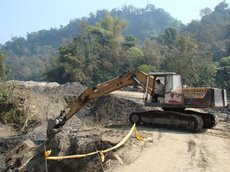
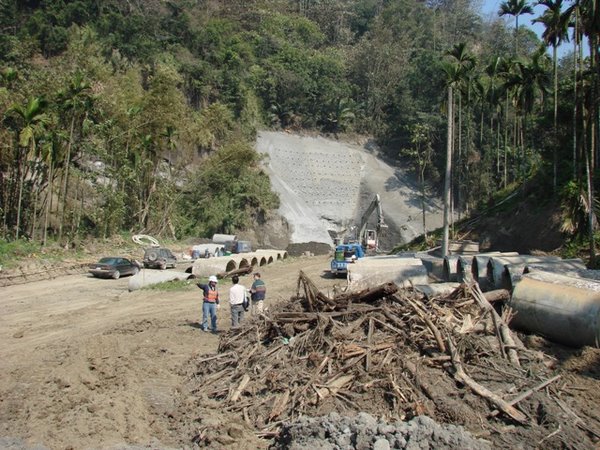
Hushan Dam site: 3 March 2008.
 Same area as above, 4 February 2007.
 Same area as above, 14 June 2007.
Hushan Dam site visit: 3 March 2008 


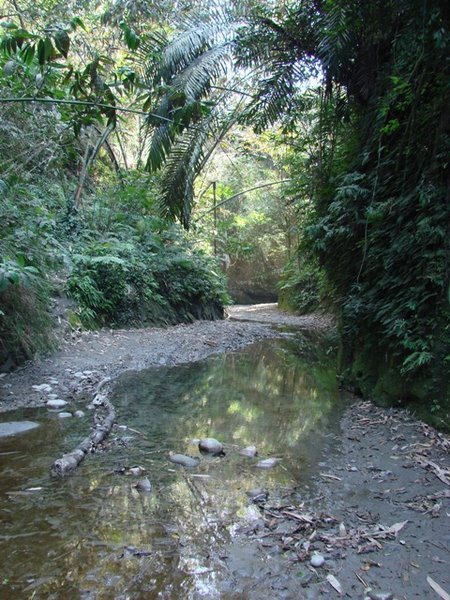
Hushan, as it was !
See: Hushan Dam: NGO site visit
Also see:
Reflections on the destruction at Hushan
The destruction continues
For some earlier photos of construction work at the Hushan Dam site click here.
Wednesday, March 12, 2008
Hushan Dam site visit: Photos

Friday, March 7, 2008
WSPA membership for Wild at Heart Legal Defense Association

We are delighted to learn that Wild at Heart Legal Defense Association , a very active member of our Taiwan National Coalition Against the Hushan Dam, have been accepted as a World Society for the Protection of Animals (WSPA) member society.
"The World Society for the Protection of Animals (WSPA) is the world’s largest network for animal welfare. It brings together over 880 member societies in 153 countries and a whole community of individuals around the world who care about animal welfare." - WSPA International
Wild becomes the third Taiwan based WSPA member society. The three Taiwan based WSPA member societies are EAST (Environment and Animal Society of Taiwan); Life Conservationist Association; and most recently Wild at Heart Legal Defense Association. Wild has cooperated with and worked alongside EAST a number of times in the past and they both remain members of the Taiwan National Coalition Against the Hushan Dam.
We congratulate Wild on their WSPA membership and look forward to WSPA and their member societies involvement in the Hushan Dam-Fairy Pitta issue, the plight of the Taiwan humpback dolphins, and other Taiwan issues.
Hushan Dam: NGO site visit
 Hushan, as it appears now. March 3, 2008 NGO visit.
On the morning of Monday, 3rd March, various NGOs and individuals had a meeting in Douliou City before going to visit the Hushan Dam site later in the day. Amongst others were Taiwan National Coalition Against the Hushan Dam (TNCAHD) representatives from Taiwan Environmental Protection Union (TEPU), Wild at Heart Legal Defense Association, Taiwan Academy of Ecology, and Wild Bird Society of Yunlin.
At 13:30 NGOs, press and concerned individuals met with the Central Region Water Resources Office (CRWRO) of the Water Resources Agency at their offices in Hushan. What follows are some general impressions and observations made by a TNCAHD member present.
The Central Region Water Resources Office hosted a meeting/presentation in an old classroom in the former Trans-World College Campus in Hushan. Central Region Water Resources Office Deputy Director, Chiang Ming-Lang, seemed to be in charge of proceedings and stood handing out business cards while for a time a large image of the Taipei 101 building appeared on the presentation screen in the meeting room as the visitors arrived.
Chiang and his office seemed ill prepared for the for the presence of members of the international community. No interpreter was available nor was any non-Mandarin material or information available. Considering the international interest in the Hushan issue and the considerable numbers of letters of concern sent to the Taiwanese Government by large international groups like BirdLife International, The Royal Society for the Protection of Birds (RSPB), The Humane Society International (HSI), and National Resources Defense Council (NRDC) this was the first in a number of observations that tended to give the impression of a very inward looking and closed-minded attitude of the CRWRO in their dealings with NGOs and other non-governmental individuals or groups. English has been called the unofficial "second language" of Taiwan. Some government departments religiously prepare some English material for presentations where they know or expect foreign involvement but this differs from department to department.
At the presentation the thirty-strong visiting group, made up of concerned individuals and members of the press and NGOs, seemed to be almost outnumbered by seemingly uninvolved CRWRO and Taisei Corporation workers. During the presentation a number of these people would walk in and out of the classroom and would gather in small groups outside smoking and chatting while staring through the windows at the visitors. Was this perhaps an attempt at intimidation or just too many under-worked CRWRO bureaucrats with nothing better to fill their day with than the opportunity of staring at all the environmentalists that had come to view their handiwork?  Bored bureaucrats ?
The presentation included slides of officials allegedly saving creatures, such as the endangered Yellow-margined Box Turtle Cuora flavomarginata flavomarginata, and a number of indigenous plants. The attitude seemed to be one of, "You see ! We did it right ! We helped save all those little creatures you were so worried about. We know we didn't let you come and watch us because we didn't want you interfering with our important development but trust us, we know what we're doing so what was all the fuss about?" 
The Presentation
After the presentation the visitors were handed bright yellow hardhats. Our CRWRO and Taisei hosts wore red or orange ones. Visitors were then put on bus and a minivan and escorted by a few private cars, were driven to the dam site. The vehicles whizzed past workings that our hosts had obviously decided were not to be viewed regardless of whether we had an interest in these specific working areas or not. The full impact of a cleared Hushan was quite a shock. Hills stood treeless and clear of vegetation. Much of Hushan, as we knew it, now lay in ruins, gone forever !
Visitors were taken to only two working areas. At the second area an official working on the "conservation" and "rehabilitation" of the area lamented to the media how environmentalists continually interfere with his work. Quite how environmentalists interfere with his work on a site that they are bared from entering was not explained. The concept of non-governmental-parties having concerns for what was being done behind closed doors on the site and how it was being done didn't seem to be a legitimate reason to question his work. He clearly seemed to think he was only accountable to government and the developers. The fact that a considerable some of money, around 200 million NT Dollars, has been earmarked for "conservation" and "rehabilitation" on the project and that the public should have a right to know how that money is being spent, again, didn't appear to count for very much.  Clearing Hushan
Visitors were then taken to an area outside the construction area and shown a very small cleared area set amongst exotic bamboo and betel nut palms. Within the cleared area totaling a few hundred square metres, if that, were a few plants. This, we were told, was what they had saved from the construction site. We were made to understand that some trees still had to be moved but somehow, after having viewed the hundreds of hectares of cleared land, these few plants didn't seem very much.
The saved plants
Click for site visit photos.
Also see:
Reflections on the destruction at Hushan on the Wild at Heart website.
The destruction continues
Hushan's Fairy Pittas at the Jeju Wildlife Research Center Workshop in South Korea
 Dolhareubang, the old man of Jeju. The Dolhareubang totem can be seen all over Jeju.
In late February our colleagues at Wild at Heart Legal Defense Association sent two delegates to the Annual Jeju Wildlife Research Center Workshop on Jeju Island, South Korea. Jeju Island, along with Taiwan, Southern Japan, and Southern China are the breeding areas for the IUCN Red Listed Fairy Pitta Pitta nympha. Dr Lin Reuy-shing of the Taiwan Endemic Species Research Institute and Mark Wilkie of Wild at Heart Legal Defense Association delivered presentations on the Fairy Pitta in Taiwan.
Dr. [Scott] Lin Reuy-shing, Assistant Senior Researcher at the Taiwan Endemic Species Research Institute has studied the Fairy Pitta for the last decade and is considered an international expert on the species. Dr. Lin delivered a presentation titled (abstract below), "A review and perspective of Fairy Pitta research in Taiwan."
Mark B. Wilkie, a South African expat, works as a naturalist for Wild at Heart Legal Defense Association, Taiwan. He has been involved with Fairy Pitta conservation in Taiwan for the past five years. He also serves as a super moderator on Birdforum the net's largest birding community dedicated to wild birds. Mark Wilkie delivered a presentation titled (abstract below), "Conservation and threats to the Fairy Pitta: The Huben IBA, Taiwan." The presentation included the likely negative impact that the Hushan Dam Project will have on the Fairy Pitta and other threatened species such as the Swinhoe's Pheasant Lophura swinhoii and the unique Taiwan population of humpback dolphins Sousa chinensis.
What follows is an account of Jeju Wildlife Research Center Workshop.
The 2008 Annual Jeju Wildlife Research Center Workshop,
Jeju Island, South Korea  A group photo at the workshop.
Introduction
Contact with Jeju Wildlife Research Center (JWRC) was first established in January 2007 before the 2007 Jeju Wildlife Research Center Workshop. We were not able to attend this workshop but interest in the work of JWRC developed. Contact was maintained through e-mails with Yong-chang Jang, JWRC External Cooperation Director. Yong-chang Jang also had contact with Wilkie through Birdforum.
In August 2007 Eun-Mi Kim, JWRC President, attended the 2007 International Symposium for the Fairy Pitta held in Dounan, Taiwan. She delivered a presentation titled, "The distribution and habitat of the Fairy Pitta on Jeju Island, South Korea." At the symposium Kim met both Lin and Wilkie. The idea of future cooperation was discussed at the symposium and Lin and Wilkie were invited to the 2008 Annual Jeju Wildlife Research Center Workshop. JWRC kindly offered to host Lin and Wilkie for the period of the workshop and Wild at Heart Legal Defense Association (Wild) agreed to fund the airfare and additional costs.
Goals
The goals of the trip were:
- To establish cooperation on Fairy Pitta research between Korean and Taiwan researchers.
- To propose the use of standardised research methods for better comparison of regional data at an international level.
- To give Korean researchers a better understanding of Fairy Pitta research that had been undertaken in Taiwan and to share ideas on future Fairy Pitta research and conservation.
-To create awareness of the threats to the Fairy Pitta in Taiwan and the conservation shortfall.
- To gain a general overview of the nature of Fairy Pitta habitat and nesting sites on Jeju and threats facing the species.
The Trip
Friday, February 22, 2008 Folklore & Natural History Museum of Jeju.
We arrived at Jeju International Airport just before 14:00 and were met by Eun-Mi Kim, JWRC President, and her husband, Chang-Wan Kang, a well known Korean wildlife photographer. From the airport we went to the Folklore & Natural History Museum of Jeju where we met the museum's Wan-Byung Kim. Mr Kim introduced us to the natural history of Jeju Island and also allowed us to examine two Fairy Pitta specimens in the museum's possession.
From the museum we proceeded to the National Ecology Experience Exhibition Hall at the Halla Arboretum where we were to meet up with other delegates. The hall was also the venue for the workshop. There was about an hour before the other delegates from Seoul arrived so we were able to spend a little time going around the arboretum and doing a little birding.
About an hour later we met up with local JWRC members and delegates from the Korean mainland. We viewed a photographic exhibition of Jeju birds and other wildlife that had been put up for the workshop and were also able to go around the National Ecology Experience Exhibition Hall. Photographic exhibition in the National Ecology Experience Exhibition Hall put on for the workshop.
From the Halla Arboretum delegates proceeded to dinner and then checked in at the motel we were staying in for the duration of the trip.  Photographic exhibition sign.
Saturday, February 23, 2008
We arrived at the National Ecology Experience Exhibition Hall at about 8:30. After getting ready for our presentations and spending a short time in the arboretum the workshop began at around 9:50. Eun-Mi Kim and Dr. Lin Reuy-Shing during the workshop presentations.
- Opening of Workshop - Mr. Nam-Joon Ji.
- JWRC President's address - Mrs. Eun-Mi Kim.
- Amphibians and Reptiles of Jeju Island - Mr. Young-Ho Kim.
- A review and perspective of Fairy Pitta research in Taiwan - Dr. Reuy-Shing Lin.
- Report of trip to birding spots in Korea for news articles - Mr. Hee-Man Kang.
- Short thoughts on birds (History of Korean Ornithology) - Dr. Jin-Young Park.
- Black-faced Spoonbills on Jeju Island - Mr. Nam-Joon Ji.
- Conservation and threats to the Fairy Pitta: Huben IBA, Taiwan - Mr. Mark Wilkie.
- Environmental impact of [Taean] oil spill* - Dr. Hwa-Jung Kim.
After completion of the presentations delegates embarked on a field trip to view wetlands and coastal regions in Western Jeju.
*Taean Oil Spill The icy Jeju coast.
Sunday, February 24, 2008
 Hallasan National Park.
This day was spent in the field. The group started the day going around the Halla Arboretum. From the Halla Arboretum the group split and embarked for Southern Jeju. The second group, led by Mr. Nam-Joon Ji, traveled south via Hallasan National Park. Mount Halla (1950m) is South Korea's highest mountain. Hallasan National Park is a UNESCO World Natural Heritage Site. Jeju's unique lava tubes are a not to be missed sight on Jeju. From Daepo-dong on Jeju's southern coast the group followed the coastline eastwards through wetlands and coastal areas all the way back to Jeju City in the north. Some workshop delegates in the field.
Monday, February 25, 2008
Monday was devoted to Fairy Pitta research. Eun-Mi Kim, Chang-Wan Kang, Ruey-Shing Lin, and Mark Wilkie spent the day visiting and viewing Fairy Pitta habitat and known previous nesting sites. Fairy Pitta arrive in Jeju in mid to late May. This is about a month later than those arriving in Taiwan.  Cheonjiyeon Waterfall, Southern Jeju.
Tuesday, February 26, 2008
We planned to visit two nesting sites on Tuesday morning before our flight back to Taiwan. Because of weather conditions we were only able to visit one site. Snow prevented us from getting to the second site.
Conclusion
The Workshop was a great success. For us, it helped in establishing future cooperation for Fairy Pitta research and conservation and gave us all a better understanding of where research is at in South Korea and Taiwan. It also gave us a greater understanding of threats to the species within its international range. It allowed us to share ideas. Eun-Mi Kim will be coming to Taiwan in late April for about a week. She will deliver a presentation to the Taiwan Endemic Species Research Institute and also spend time in the field in the Huben-Hushan area with Dr. Lin and his team.
Acknowledgements and thanks
Firstly, our thanks goes to the Jeju Wildlife Research Center for inviting us to their annual workshop and hosting us. It was indeed a great honour to be able to deliver our presentations at their workshop alongside some of South Korea's most respected researchers.
We were overwhelmed by the hospitality of the Jeju Wildlife Research Center and its members. They really made us most welcome and extended the very best of Jeju hospitality to us. Thank you ! Special thanks must also go to Eun-Mi Kim, and Chang-Wan Kang for all of their work and our grateful appreciation to our friends Nam-Joon Ji, Hee-Man Kang, Yong-chang Jang, Young-Ho Kim, Wan-Byung Kim, and Charlie who made our trip so memorable.
Our appreciation also extends to our fellow delegates Dr. Jin-Young Park, Dr. Hwa-Jung Kim, Dr. Woong-Seo Kim, and Barry Heinrich for sharing their knowledge with us and making the field trips so memorable.
Finally, our thanks to Wild at Heart Legal Defense Association for their support and for the funding of the air travel.
List of birds seen during the Jeju Workshop field trips Brown-eared Bulbul Ixos amaurotis
Bird List
Phasianus colchicus Common Pheasant
Anser fabalis Bean Goose
Anser erythropus Lesser White-fronted Goose
Aix galericulata Mandarin Duck
Tadorna tadorna Common Shelduck
Anas strepera Gadwall
Anas penelope Eurasian Wigeon
Anas platyrhynchos Mallard
Anas poecilorhyncha Spot-billed Duck
Anas clypeata Northern Shoveler
Anas acuta Northern Pintail
Anas crecca Common Teal
Aythya ferina Common Pochard
Aythya fuligula Tufted Duck
Bucephala clangula Common Goldeneye
Mergus serratorRed-breasted Merganser
Mergus merganser Common Merganser
Columba livia Rock Pigeon
Streptopelia orientalis Oriental Turtle-Dove
Gallinula chloropus Common Moorhen
Fulica atra Common Coot
Tringa ochropus Green Sandpiper
Tringa hypoleucos Common Sandpiper
Calidris alpina Dunlin
Pluvialis squatarola Grey Plover
Vanellus vanellus Northern Lapwing
Larus crassirostris Black-tailed Gull
Larus glaucescens Glaucous-winged Gull
Larus hyperboreus Glaucous Gull
Larus argentatus Herring Gull
Larus mongolicus Mongolian Gull
Larus heuglin Heuglin's Gull
Larus schistisagus Slaty-backed Gull
Rissa tridactyla Black-legged Kittiwake
Pandion haliaetus Osprey
Milvus migrans Black Kite
Buteo buteo Common Buzzard
Circus spilonotus Eastern Marsh-Harrier
Accipiter nisus Eurasian Sparrowhawk
Accipiter gentilis Northern Goshawk
Aquila clanga Greater Spotted Eagle
Falco tinnunculus Common Kestrel
Falco peregrinus Peregrine Falcon
Tachybaptus ruficollis Little Grebe
Podiceps cristatus Great Crested Grebe
Podiceps nigricollis Black-necked Grebe
Phalacrocorax carbo Great Cormorant
Phalacrocorax capillatus Japanese Cormorant
Phalacrocorax pelagicus Pelagic Cormorant
Egretta garzetta Little Egret
Egretta sacra Pacific Reef-Egret
Ardea cinerea Grey Heron
Casmerodius albus Great Egret
Nycticorax nycticorax Black-crowned Night-Heron
Platalea leucorodia Eurasian Spoonbill
Platalea minor Black-faced Spoonbill
Gavia stellata Red-throated Loon
Gavia arctica Arctic Loon
Gavia pacifica Pacific Loon
Lanius bucephalus Bull-headed Shrike
Pica pica Black-billed Magpie
Corvus frugilegus Rook
Corvus macrorhynchos Large-billed Crow
Monticola solitarius Blue Rock-Thrush
Zoothera dauma Scaly Thrush
Turdus pallidus Pale Thrush
Turdus eunomus Dusky Thrush
Tarsiger cyanurus Orange-flanked Bush-Robin
Phoenicurus auroreus Daurian Redstart
Parus ater Coal Tit
Parus major Great Tit
Parus varius Varied Tit
Regulus regulus Goldcrest
Ixos amaurotis Brown-eared Bulbul
Zosterops japonicus Japanese White-eye
Cettia diphone Japanese Bush-Warbler
Alauda arvensis Eurasian Skylark
Passer montanus Eurasian Tree Sparrow
Motacilla alba White Wagtail
Motacilla cinerea Grey Wagtail
Anthus hodgsoni Olive-backed Pipit
Anthus rubescens Buff-bellied Pipit
Carduelis sinica Oriental Greenfinch
Carduelis spinus Eurasian Siskin
Coccothraustes coccothraustes Hawfinch
Eophona migratoria Yellow-billed Grosbeak
Eophona personata Japanese Grosbeak
Emberiza cioides Meadow Bunting
Emberiza elegans Yellow-throated Bunting Daurian Redstart
Phoenicurus auroreus  Varied Tit Parus varius
Mammals
Roe Deer Capreolus pygarus tianschanicus Roe Stag Capreolus pygarus tianschanicus
Also see:
Korean Fairy Pitta researcher visits Huben
Abstracts
A review and perspective of Fairy Pitta research in Taiwan
Ruey-Shing Lin (1), Wan-Jyun Chen (2), and Pei-Fen Lee (2)
1. Taiwan Endemic Species Research Institute, 1 Ming-Shen East Road, Jiji, Nantou 552, Taiwan.
2. Institute of Ecology and Evolutionary Biology, National Taiwan University, Taipei 106, Taiwan.
ABSTRACT
Tropical and subtropical Asia is currently confronting particularly severe forest conversion pressure. The vulnerable Fairy Pitta (Pitta nympha) is an understudied passerine which breeds in the low-elevation forests of eastern Asia and probably winters on Borneo. Because of severe habitat loss, suitable habitat within its breeding and wintering ranges as well as on its migration routes might not be sufficient to maintain its population. Additionally, there are few published intensive studies on migrating pitta species. Thus, there is an urgent need to establish knowledge of all aspects of their ecology and biology and then to propose suitable management measures to conserve this threatened species. In this speech, I will first illustrate what we have done between 2001 and 2007 in Taiwan, and then make a brief introduction to some of our ongoing research projects. Finally, I will outline a conservation plan for the Fairy Pitta over the next decade based on our current knowledge.
Historically, Fairy Pitta was believed to be a rare summer breeder in Taiwan. After a preliminary survey in Huben Village, Linnei Township, Yunlin Couty in west-central Taiwan in 2000, we found it probably was not as rare as previously thought and we thereafter initiated long term studies. At first, we tested the effectiveness of using playback of recorded calls to census the presence and abundance of Fairy Pitta in early summer of 2001. Since the detectivity of Fairy Pitta was significantly increased when playback was used, we then started using playback to survey the distribution of Fairy Pitta and to monitor the population status on different spatial scales, i.e., Huben Village, Linnei Township and Douliou City, and finally the whole of Taiwan. Additionally, the data was used to model the potential spatial distribution in areas we did not visit.
The diet of nestling Fairy Pitta was also studied by videotaping from 2000 to 2002. Results indicated that Earthworms were the most important food item for all broods and occurred in more than 73% of the adult’s feeding visits. Also, adults usually brought 1-3 items at each feeding visit to nestlings, and the prey sizes were usually 2-10 cm in length. The total number of food provisionings to provide food for nestlings was estimated to be around 900-1000 based on a brood observed for the entire nestling period.
In order to propose feasible habitat management strategies for land managers, we studied nest site selection and the possible effects of habitat conversions, i.e., bamboo plantation, over three breeding seasons from 2004 to 2006 on Fairy Pitta in Huben Village where the area is predominantly planted with bamboo (Dentrocalamus latiflorus). In general, Fairy Pitta chose to nest in areas with increased canopy cover and a diversity of trees coupled with decreased shrub density immediately around the nest and moderate small shrub density near the nest and situated at a moderate distance from the nearest tree. Also, nests built in places with higher overhead cover, with a steeper downward slope and with greater difficulty to access were more successful. Although bamboo density was not included in the best nest site selection models, it did significantly negatively correlate with the diversity of trees. Therefore, we recommend that managers protect remaining broadleaf forests and restore similar habitat in areas of rough terrain, usually found along valleys, to enlarge areas of suitable habitat.
Since nest predation is the most important factor causing nest failure for Fairy Pitta, we monitored their breeding success in Huben Village from 2003 to 2007 and identified their nest predators by continuously digital video-taping during the 2006 and 2007 breeding seasons. Snakes were the most important predators, followed by large mammals, such as macaque, mongoose and civet. A Crested Serpent Eagle was observed once attacking nestlings.
Finally, we report on some resighting records from 152 color-banded Fairy Pittas that were captured in 2001, 2004 and 2005 to index their breeding site fidelity and to compare the differences in return ratios between adults and fledglings, and also between males and females within the Huben Village study area. Between 2004 and 2007, we resighted Fairy Pitta with bands 19 times, and of those, ten individuals were identified from fifteen resightings. The return ratio of fledglings (1/99) was significantly lower than it was in the adults (9/53). Among nine adults, only two were female. However, the difference between the two genders was not significant. The mean distance between banded and resighted positions was around 130m, ranging from 19-300m. Since the diameters of the various Fairy Pittas’ territories also ranged from 100-300m, it indicated that adults often returned to sites close to or in their original territories. The return rate of adults in Huben Village was around 16-26%. However, this value has probably been underestimated because of their secretive habits.
Currently, we are using the telemetry technique to study the fluctuations of home range and activity pattern within the breeding cycle and the movement and survival rates of young and adults during the period that Fairy Pitta stay in Taiwan. In addition, we are refining the spatial prediction models of Fairy Pitta in Taiwan and trying to estimate their population size. Probably, we will also model their spatial distribution within their breeding and wintering range. Since the connections between breeding and wintering populations are important for the conservation of Fairy Pitta, we plan to use molecular approach and isotopes to construct the spatial population structure among South Korea, Japan, China and Taiwan. If the population structure is significant, we then can use these tools to link the breeding and wintering populations in the future.
Conservation research of the migratory Fairy Pitta is generally more complicated than the other non-migratory pitta species. Based on the status quo and analyses of priorities, we outline current issues, set conservation goals and propose actions to accelerate the conservation of the Fairy Pitta over the next decade.
Conservation Issues
Inadequate understanding of population size and distribution, especially in south-east China and in its wintering range: Sighting records and surveys in small areas has been compiled. However, no extensive surveys across its distribution range have been made. Additionally, the actual wintering grounds for the species, has until now, remained somewhat of a myth.
Habitat loss, degradation, and fragmentation: Breeding habitats in south-east China and wintering habitats probably have been destroyed at a rapid rate. In other breeding areas, afforestation and modification in broadleaf forests have continuously degraded the remaining habitat.
More research work: Research is urgently needed on the ecology of habitat requirements, especially on specific structural features, landscape configurations, and amounts of habitat that are required to maintain a source sub-population in developing scientifically based management measures, such as designs of land-use projects, protected areas and habitat restoration.
Impact of climate change: Although the impact is not clear, it has the potential to affect the Fairy Pitta population through increasing temperature and uncertainties in rainfall that will certainly affect its distribution, food resources, and habitat requirements, and also through the changes in weather patterns on migration routes.
Conservation goals
Improve our understanding of the distribution of Fairy Pitta and its habitat requirements.
Initiate an international conservation action plan to reflect current knowledge.
Promote a coordinated international network of conservation partners to implement the action conservation plan.
Recommended actions
Conduct surveys throughout their distribution range to assess their population, distribution and conservation status.
Implement a standardized monitoring program within the breeding range. This is critical for all stages of conservation planning and important for monitoring their population trend, especially before the identification of wintering grounds.
Identify critical wintering habitat and study the linkage between breeding and wintering populations. These are necessary for protection and restoration because areas of their wintering habitat might be severely degraded in the near future. Methods for identifying the wintering grounds should be developed.
Monitor and track the amount, condition and configuration of the important habitat used in all phases of the Fairy Pitta annual cycle by GIS and remote sensing techniques.
Conduct research to identify areas of high-quality habitat and landscapes in terms of fecundity and survival across their annual cycle, and frequency and scale of dispersal among populations across their range. This information is valuable for their conservation.
Create well-coordinated partnerships to accelerate the implementation of conservation actions in nations where the Fairy Pitta stays or passes through.
Protect known important hotspots and retain remaining high-quality habitat. Restore similar habitat to defragmented and enlarged forest tracts that are large enough to support several source populations and other priority species. Also, examine the birds’ responses to management measures.
Develop community-involvement and scientifically sound forest management measures in areas of important breeding habitat.
The challenges of Fairy Pitta conservation reflect the status quo of many threatened forest birds in this region. To effectively conserve migratory landbirds, it is necessary to raise more conservation awareness and place more effort on carrying out well-coordinated monitoring studies beyond political borders.
Conservation and threats to the Fairy Pitta Pitta nympha:
The Huben IBA, Taiwan.
Mark Bruce Wilkie
Wild at Heart Legal Defense Association,
12F.86 Chongcing South Road Section 1, Taipei 10045, Taiwan.
Abstract
Taiwan falls within in the breeding range of the Fairy Pitta (Pitta nympha). In mid to late April this dazzling insectivorous terrestrial suboscine passerine arrives in Taiwan to breed. The Fairy Pitta has been listed as vulnerable (BirdLife International 2001) due to a sharp decline in numbers. The Huben Important Bird Area (IBA) in Yunlin County, west-central Taiwan is an important breeding area for the species. Taiwan has a total of 53 internationally identified IBAs. For its size, Taiwan has a very high number of IBAs. Only 11 or 21% fall within totally protected areas. 17 IBAs or 32% fall within partially protected areas. That leaves 25 or 47% of Taiwan’s IBAs without any protection. Huben falls amongst those IBAs without any protection (BirdLife International 2004).
The Huben-Hushan area has been listed as one of Asia’s key sites for conservation (Birdlife, 2004). The details of the Huben IBA are as follows:-
Name: Huben IBA.
Number: TW017.
Category: A1.
Admin Region: Yunlin County.
Coordinates: 23° 43’N 120° 36’E.
Altitude (highest point): 519m.
Area: 2,200 ha.
Habitats: Artificial landscapes (terrestrial); Forest.
Threatened Species: Fairy Pitta Pitta nympha.
Protected Area Status of the IBA: Unprotected.
In this presentation delegates will be introduced to the Huben IBA and the threats facing it, most notably, loss of habitat through construction-related so-called development projects such as the Hushan Dam Project and the concreting and barricading of streams to allegedly reduce erosion. In many ways the Huben IBA can be seen as a microcosm of what is happening to the Fairy Pitta throughout its range. Briefly, some of the conservation measures and efforts that have been taken to address the plight of this species will be looked at. Finally, the point that meaningful Fairy Pitta conservation can’t take place without international cooperation is made in the hopes that a multinational effort to address the plight of this delightful forest passerine can be brought about.
Friday, February 29, 2008
A Brief Hushan Update
 Hushan Dam access control point.
With the Lunar New Year holidays and a trip to Korea we haven't been able to post much during February. No fear. The silence doesn't mean things haven't been happening. On the legal front Wild at Heart has been working away on the issue. Taiwan Endemic Species Researcher, Dr. Lin Reuy-shing and Wild at Heart member, Mark Wilkie, attended the Jeju WildLife Research Centre Workshop on Jeju Island, South Korea, from Feb 22-26 and gave presentations on the Fairy Pitta. Jeju Island is an important breeding area for the Fairy Pitta. Dr. Lin covered current research on the Fairy Pitta in Taiwan and Wilkie delivered a presentation on the threats to the species which included the Hushan Dam issue. Another goal of the trip was to establish a closer working relationship between Korean and Taiwan researchers and conservationists. On Monday 3 March 2008 we will be visiting the Hushan Dam site and a meeting of concerned parties will also take place. Access to the Hushan Dam site is restricted and this will be the first time in months that we've been allowed into the area. Reports on what has been happening and Monday's visit will be posted next week.
Photos taken on our last visit several months ago. We were allowed into the area but were not allowed near the workings so these photos were taken from the gate.

More Taiwan Endemics for Hushan
 Taiwan Scimitar Babbler Pomatorhinus musicus-Photo courtesy of Richard Yu. Copyright Richard Yu.
The International Ornithological Committee (IOC) updated their World Bird List (Gill & Wright list) on 13 February 2008. The IOC List now credits Taiwan with 23 endemic birds. We have now seen 8 new endemics added in the last two years. We've updated a list of endemics which can be viewed below. Taiwan is now looking very attractive to foreign birders with 23 endemics and the likelihood of possibly another 3-5 more within the next 2-3 years.
Taiwan Endemic Species:
Taiwan Whistling Thrush Myophonus insularis *
Swinhoe’s Pheasant Lophura swinhoii *
Taiwan Blue Magpie Urocissa caerulea *
Taiwan Partridge Arborophila crudigularis *
White-eared Sibia Heterophasia auricularis *
Steere’s Liocichla Liocichla steerii *
Styan’s Bulbul Pycnonotus taivanus
Yellow Tit Parus holsti
Mikado Pheasant Syrmaticus mikado
Collared Bush Robin Tarsiger johnstoniae
Flamecrest Regulus goodfellowi
White-whiskered Laughingthrush Garrulax morrisonianus
Taiwan Barwing Actinodura morrisoniana
Taiwan Yuhina Yuhina brunneiceps
Taiwan Bush Warbler Bradypterus alishanensis
Taiwan Hwamei Garrulax taewanus
Taiwan Barbet Megalaima nuchalis *
Taiwan Scimitar Babbler Pomatorhinus musicus *
Black-necklaced Scimitar Babbler Pomatorhinus erythrocnemis *
Taiwan Wren-Babbler Pnoepyga formosana
Rufous-crowned Laughingthrush Garrulax ruficeps
Rusty Laughingthrush Garrulax poecilorhynchus *
Taiwan Fulvetta Alcippe formosana *
*Recorded in the Huben-Hushan area.
(As per Birds of the World: Gill, F. and M.Wright. 2006. Birds of the World: Recommended English Names. Princeton NJ: Princeton University Press, updated 2008-1-17)
Thursday, February 7, 2008
Happy New Year !

Xin Nian Kuaile !
To all those celebrating the Lunar New Year we wish you a Happy New Year and all the best for the Year of the Rat !
Sunday, January 27, 2008
Taiwan down 16 places on the EPI
 The Taipower power plant at Wuchi, Taichung. Recently named in Nature Magazine as the world's dirtiest power plant.
Taiwan has dropped sixteen places to No. 40 according to this year's edition of the Environmental Performance Index (EPI). The EPI rates international environmental performance and is released annually by environmental specialists at Yale University and Columbia University. In last year's EPI Taiwan ranked No. 24. With Taiwan's emissions records this isn't surprising and only serves to highlight Taiwan's abysmal environmental record and just how much Taiwan's Environmental Protection Administration (EPA) seems to be bending over backwards to accommodate developers. In recent months we have seen highly controversial projects like the Hushan Dam Project just steamrolled through the EIA process with many questioning the legality of these actions. Clearly, Taiwan risks further isolation if they don't start cleaning up their act and doing something about their environmental record.
See Taiwan drops 16 spots in environmental protection in today's Taipei Times.
Friday, January 18, 2008
Report of the 2nd International Workshop on Conservation & Research Needs of the Eastern Taiwan Straight Population of Indo-Pacific humpback Dolphins

The Report of the Second International Workshop on Conservation and Research Needs of the Eastern Taiwan Straight Population of Indo-Pacific humpback Dolphins, Sousa chinensis, held from the 4-7 September 2007, in Changhua City, Taiwan, is now out.
The report covers the issue of how the Hushan Dam will reduce the flow of freshwater into the Jhoushuei River Estuary and degrade critacally important humpback dolphin habitit.
Sunday, January 13, 2008
Summary of the press coverage of the establishment of the Eastern Taiwan Strait Indo-Pacific Humpback Dolphin Technical Advisory Working Group
This week saw the announcement of the establishment of the Eastern Taiwan Strait Indo-Pacific Humpback Dolphin Technical Advisory Working Group (ETSSTAWG). ETSSTAWG is an international team of 17 scientists dedicated to the plight of Taiwan’s remaining Indo-Pacific humpback dolphins (Sousa chinensis). ETSSTAWG will provide expert advice, guidance and scrutiny related to conservation issues for this isolated and endangered population of dolphins, at the request of stakeholders, policymakers, agency officials, and other interested parties. What follows is a summary of local press coverage (English) and comments.
Newspapers
Taipei Times:
1. Groups make bid to save 'Matsu fish'
The article starts by stating 'The dolphins are also known as "Matsu fish" because they generally appear along the west coast around the March birthday of the sea goddess.' This is misleading as it implies that these dolphins aren't resident and only appear at certain times of the year. In fact, the dolphins are frequently seen throughout the summer and have been spotted during some winter months, including December, so would appear to be resident.
The Taiwan Strait is influenced by the north-easterly wind, and for three quarters of the year, the turbulent sea is covered in whitecaps, making observation of a white-coloured dolphin difficult (Humpback dolphins are not charismatic jumpers so generally just dorsal fins and parts of the back can be observed.). After about the middle of the third month of the lunar calendar, the sea becomes calmer, and the dolphins become easier to distinguish from the waves. The birthday of the sea goddess Matsu falls around this time, on the 23rd of the third month of the lunar calendar. Therefore, it is said that these dolphins appear in the area to wish Matsu a happy birthday.
The article also incorrectly refers to the "Matsu's Fish Conservation Union" as the "Matsu Fish Protection Alliance."
The article also states that Ecology Academy General Secretary Chen Bing-heng had said 'conservation experts from countries such as Canada, Japan and the US passed a resolution in an international conservation seminar in Taiwan in September establishing a consultancy group that offers assistance on Indo-Pacific humpback dolphins conservation.' Chen was speaking in Mandarin and it would seem that some of what he said has been misinterpreted.
Firstly, Chen is Secretary General of the Taiwan Academy of Ecology. The "seminar" would in fact be the Second International Workshop on the Conservation and Research Needs of the Indo-Pacific Humpback Dolphins, Sousa chinensis, in the waters of western Taiwan held in Changhua City in September 2007, hosted by the National Museum of Marine Biology and Aquarium (Taiwan) and co-hosted by FormosaCetus Research & Conservation Group, and Wild at Heart Legal Defense Association. The workshop included several government departments and international NGOs amongst its sponsors. This workshop was clearly more than just a "seminar."
There wasn't a resolution passed at the September workshop establishing a consultancy group but rather an undertaking to form a steering committee tasked with putting together and establishing a scientific advisory group. The advisory group, the Eastern Taiwan Strait Indo-Pacific Humpback Dolphin Technical Advisory Working Group (ETSSTAWG), was formally established in Washington DC on 8th January 2008.
2. CPC, Formosa ordered to study impact on dolphins
The article starts by stating 'The government has sought measures to protect endangered dolphins before CPC Corp, Taiwan and Formosa Plastics Group spend US$20 billion on chemicals and steel plants on the west coast.' The article does not elaborate on what those measures are but implies that the government has sought specific protection measures. Humpback dolphins were listed as a protected species under Taiwan's Wildlife Protection Act (WPA) before the Eastern Taiwan Strait population was discovered in 2002. Nothing specifically has been added to its already existing protected species status so the government hasn't taken additional measures to protect the dolphins under the WPA.
The government has through co-sponsorship of two dolphin workshops shown some desire to learn a little more about the dolphins but have not acted on the recommendations made in the workshop to address the plight of the dolphins. If these actions can be interpreted as the government seeking measures to protect the endangered dolphins before CPC Corp, and Formosa Plastics Group spend US$20 billion on chemicals and steel plants on the west coast would be highly debatable.
Edward Huang, director-general of the Environmental Protection Administration's planning department, is quoted as saying 'If the dolphins are found near the sites, the companies will have to come up with measures to ensure these animals won't be disturbed' and 'Indo-Pacific humpback dolphins are endangered and it's an international practise to project them.' Clearly, the dolphins are found around the sites as international scientific peer-reviewed papers presenting evidence of their presence show. The fact that Edward Huang refuses to acknowledge this only serves to highlight the concerns of environmental groups that the EPA seems to favour developers and neglects its duty of protecting the environment.
Roy Chiu, president of Kuokuang Petrochemical Technology Co, a venture led by state-run oil refiner CPC, and the Formosa Plastics Group is quoted as saying 'We don't think Kuokuang will affect the habitat of the dolphins' and 'We would like to know what we can do, and we know very little.' These statements from Chiu are disturbing. If Kuokuang knows very little then they only have themselves to blame. Clearly, after published research, peer-reviewed papers, recommendations and action plans resulting from two international workshops there is information out there and now Chiu has the expertise of ETSSTAWG to call on. Also, if Chiu knows very little then how can he say that he doesn't think Kuokuang will affect the habitat of the dolphins. That's a very irresponsible statement for the president of Kuokuang to make and very poor logic that clearly shows Chiu’s bias and self-interests in these statements.
There were five threats identified in the second workshop, by-catch in fishing gear; reclamation of estuarine and coastal regions for industrial purposes; diversion and extraction of freshwater from major river systems of western Taiwan; release of industrial, agricultural and municipal effluent into rivers and coastal waters; and noise and disturbance associated with construction, shipping and military activities. How Chiu can state that he doesn't think Kuokuang will affect the habitat of the dolphins is absurd. Reclamation of estuarine and coastal regions for industrial purposes is taking place. The projects rely on water from the controversial Hushan Dam Project that will reduce the flow of freshwater into the Jhoushui River Estuary. Hushan Dam is being built to supply water to these very projects. The projects are already creating noise and disturbance associated with construction through the reclaiming of land and this will increase as the projects progress. Finally, these projects will result in an increase in emissions that will result in the release of industrial effluent into the surrounding coastal waters.
Additionally, Chiu stated that 'A one-year study commissioned by Kuokuang did not spot any of the dolphins near the proposed site.' This study only dedicated three days of offshore survey, by observers whose cetacean survey experience is questionable at best, to look for cetaceans. That's hardly enough time to clearly ascertain the status of the humpback dolphins in and around the proposed site. Highly experienced and internationally respected researchers have already documented the presence of these dolphins in this area with video footage and numerous photographs.
Photo, DOLPHINS ON THEIR MINDS.
The five paper dolphins in the photo represent the five major threats to the dolphins.
China Post
Small party urges gov't to address environment
This article quotes Taipei based lawyer Robin J. Winkler as saying 'These dolphins could be extinct within 20 years ... if the government doesn't protect their habitat.' On approaching Winkler for comment he says this was taken out of context as he had explained he was not a scientist but added something like twenty years would not be far off and these dolphins most likely would become extinct sooner if immediate action isn't taken to protect them.
It should also be noted that the article identifies Winkler as a member of the advisory committee to the Green Party Taiwan. This is true but Winkler wasn't just there in his capacity of a Green Party advisor. Winkler is also director and founder of Wild at Heart Legal Defense Association, which is the secretariat of the Matsu's Fish Conservation Union.
Taiwan News
Protecting dolphins
This article is a summary of the CPC, Formosa ordered to study impact on dolphins article that appeared in the Taipei Times. See comments for that article.
Online Government News Sites
Taiwan Headlines
Gov't urged to save endangered Chinese white dolphins
This article gives the mass of a humpback dolphin as weigh between 80 and 100 kg. This is incorrect. Humpback dolphins weigh considerably more. Reeves, R.R. et al. 2002 gives the weight as: Male 260kg and Female 170kg.
CNA
Gov't urged to save endangered Chinese white dolphins
This is the same article as in Taiwan Headlines.
Radio
Radio Taiwan International
Paper Dolphin Photo
Radio Taiwan International covered events in a broadcast at 19:00 9 January 2008 and carried a photo on their website.
Summary of local Taiwanese press coverage of the establishment of the ETS Indo-Pacific Humpback Dolphin Technical Advisory Working Group
This week saw the announcement of the establishment of the Eastern Taiwan Strait Indo-Pacific Humpback Dolphin Technical Advisory Working Group (ETSSTAWG). ETSSTAWG is an international team of 17 scientists dedicated to the plight of Taiwan’s remaining Indo-Pacific humpback dolphins (Sousa chinensis). ETSSTAWG will provide expert advice, guidance and scrutiny related to conservation issues for this isolated and endangered population of dolphins, at the request of stakeholders, policymakers, agency officials, and other interested parties. The following is a brief summary of local Taiwanese press coverage in the Mandarin speaking media covering the establishment of the Eastern Taiwan Strait Indo-Pacific Humpback Dolphin Technical Advisory Working Group (ETSSTAWG). For English press summary click here.
Newspapers:
China Times
Humpback dolphins in peril - environmental groups urge government to take action, 2008.01.10.
Sudden death of oyster larvae - aquaculture industry sounds the alarm, 2008.01.10.
United Daily News
Save the Humpback Dolphins
Radio
Radio Taiwan International
Save Taiwan's National Treasure: "Taiwan Sousa Working Group" established today, 2008.01.09.
Distinctive exterior markings - Taiwan's Humpback Dolphins are Unique, 2008.01.09.
Online News Sites
The Central News Agency, CNA
Humpback dolphins in peril - Environmental groups urge Government to take action, 2008.01.09.
Yahoo News
Over-developed western coast, Humpback Dolphins are endangered, 2008.01.09.
Television
Public Television Service
Humpback dolphins are endangered, Environmental groups urge Government to take action, 2008.01.09.
Also see:
Summary of the English press coverage of the establishment of the Eastern Taiwan Strait Indo-Pacific Humpback Dolphin Technical Advisory Working Group
Friday, January 11, 2008
Greenhouse gas reduction office opens
 Formosa Plastics (FPG), Mailiao. FPG, which tops the list of industrial CO2 emissions, has yet to join the EPA's new emissions reduction program.
Yesterday the Environmental Protection Administration (EPA) opened its Greenhouse Gas Reduction Management Office. The EPA has been urging businesses to voluntarily join its emissions reduction program. To date fifty-four businesses have done so but Formosa Plastics Group, which tops the list for industrial emissions in Taiwan, has yet to join.
FPG's current development directly poses threats to the Taiwan humpback dolphins through habitat loss resulting from current and planned land reclamation projects. Many of their development projects will be supplied with water from the controversial Hushan Dam Project which will reduce the flow of fresh water into the Jhoushui River Estuary further degrading habitat critical to the survival of the small and unique population Taiwan humpback dolphins. The Hushan Dam Project is destroying over 400 hectares of the vulnerable Fairy Pitta's most important breeding area.
Environmentalists remain unconvinced that this is nothing more than green-washing as the EPA seems to do little more than talk about cutting CO2 emissions and still seems set on a pro-development course.
See today's Taipei Times for the story.
Government Agrees to Respond within Two Weeks to call for Immediate Protection Measures for Taiwan’s Humpback Dolphins
 Protesters outside the Executive Yuan at the Wednesday protest.
Taipei: Local green groups groups including Matsu’s Fish Conservation Union, Yunlin Ecological Conservation Union, Green Party Taiwan and Society of Wilderness held a press conference in front of the Executive Yuan on Wednesday January 9 in response to an announcement by a new team of international experts regarding concern for the survival of Taiwan’s unique Indo-Pacific humpback dolphins Sousa chinensis. The local groups called upon the Taiwanese government to stop evading its responsibility and ignoring the country’s Wildlife Protection Act, and to begin immediate consultations with the Eastern Taiwan Strait Sousa Technical Advisory Working Group (ETSSTAWG) as a crucial first step towards preventing this distinct Taiwanese population from disappearing, and towards protecting Taiwan’s biodiversity. After the press conference, several representatives entered the Executive Yuan to present a petition to the government.
The press conference began at 10am in front of the Executive Yuan with a skit by the participating groups, who called out “Protect Taiwan’s National Treasure!” and “Stop Formosa Steel and Kuokuang Petrochemical from destroying the humpback dolphins’ habitat!” They demanded that the government take fast, practical steps to protect the dolphin population.
After the press conference, representatives of the groups entered the Executive Yuan to present their petition. Representatives included Wild at Heart Legal Defense Association Director Robin Winkler, Taiwan Academy of Ecology Executive Secretary Chen Bing-heng, Matsu’s Fish Conservation Union Secretary Gan Chen-yi, Society of Wilderness Conservation Department Director Chou Dong-han, Taiwan Environmental Protection Union Researcher Wu Ying-ying, Taiwan Sustainable Union Director Chen Chien-chih and Yunlin Ecological Conservation Union Executive Secretary Chiu Chien-fang. The representatives were received in the Executive Yuan by the Director of Section 5 of the Executive Yuan, Ms. Siao, Deputy Director of the Forestry Bureau Mr. Lee Tao-sheng and Director of the Conservation Division of the Forestry Bureau Mr. Fang Guo-yun.
Four requests were made in the petition:
1. That the Executive Yuan give a formal response to the petition within two weeks.
2. That the Executive Yuan produce an Action Plan within two months, at the very least proposing policies regarding the five major threats faced by the dolphin population as identified at the international workshop held in September 2007 in Changhua.
3. That all discussion must be guaranteed to be kept totally open and transparent, through measures including public hearings for discussion on all related issues and allowing international groups sufficient opportunity to participate and for their opinions to be heard. These principles should be applied to the production of the aforementioned Action Plan and all subsequent planning and action.
4. That a Minister Without Portfolio should be appointed as the Executive Yuan’s window for this issue, to coordinate policies and participation between central and local government departments and to act as the main point of contact for interest groups concerned in any way with Taiwan’s humpback dolphins. All contact between government and non-governmental organizations and all information regarding development projects in the region which may impact upon the dolphins’ habitat must be kept public and transparent and open to participation by the general public.
During the discussion which followed, Mr. Robin Winkler began by stating that the aim of the petition was to plead for the survival of the unique population of humpback dolphins off Taiwan’s west coast. Winkler said that the announcement of the establishment of the Eastern Taiwan Strait Sousa Technical Advisory Working Group earlier that morning demonstrated the concern of the international community for Taiwan’s environment, and that the government should seek the Working Group’s expert advice and propose appropriate measures to deal with the dolphin population. Winkler also said that all levels of government should apply the powers authorized by the country’s Environmental Basic Law and take this Law as their prime principle in administering government affairs.
Director Chou Dong-han of the Conservation Division of the Society of Wilderness then said that, with the government currently putting great effort into trying to becoming a member of the United Nations once again, greater participation in international conservation work should be seen as an opportunity for increasing the country’s chances of achieving this goal. In addition, Chou said that the Council of Agriculture (CAO) would convene the Wildlife Conservation Advisory Committee on the 11th of January [in two days], and suggested that the COA raise the issue of conservation of the Taiwan humpback dolphins for discussion during the meeting.
The Executive Secretary of Yunlin Ecological Conservation Union, Chiu Chien-fang, said with much concern in her voice that Taiwan’s west coast natural environment was already seriously damaged, which could be seen in oyster harvests. Previously, said Chui, Yunlin oyster farms only needed to grow the oysters for eight months before they were ready for harvest. However, she said, now they need eighteen months - ecological destruction has ruined a natural resource that supported local fishing people, and this has contributed to social problems such as local unemployment and the outflow of people from the area, revealing the failure of the government’s promotion of the Sixth Naptha Cracker Plant [located in Yunlin Offshore Industrial Park]. And yet, said Chiu, the government is now promoting more pollution-intensive industry in the form of the Kuokuang Petrochemical Park and the Formosa Steel Plant, which will doubtlessly mean the end for these last livelihood options of local residents. The government should consider sustainability, not just short-term interests.
Taiwan Academy of Ecology Executive Secretary Chen Bing-heng stated that “the humpback dolphin is an indicator of the health of Taiwan’s west coast ecology” and that “if the threats they now face are not mitigated or solved, this will ultimately also be the fate of the Taiwanese people. The government should take the destruction of the west coast environment seriously.”
Ms. Siao, who was responsible for receiving the conservation group representatives, said that she would do her best to report the conservation groups’ efforts and petition to her superiors according to administrative procedures, but that she could not guarantee that it would be possible for the conservation groups to have the other results they desired within two months because of the range of issues involved, and that it the matter would have to wait until the top government levels reached a decision. However, Siao said that she would do her best to enable a decision to be reached within the following two weeks, that the process over that period would be kept transparent, and that public participation would be allowed.
The Deputy Director of the Forestry Bureau, Mr. Lee Tao-sheng, who had accompanied Siao in receiving the representatives of the conservation groups, said that responsibility for dealing with this conservation-related petition lay with the Forestry Bureau, which is the country’s highest-level government organization responsible for conservation. Lee said that he also placed much importance on the conservation of this species, and that in fact the Forestry Bureau had been one of the sponsors of the aforementioned workshop and had sent members of staff to participate. However, he said, in view of the government’s principle of working in unison, the Forestry Bureau would still have to operate according to the appropriate procedures and cooperate with other departments. Lee added that he hoped that conservation and economic development could receive equal emphasis, but that this required integration between departments and that the Forestry Bureau could not simply take a stand. It would only be possible to respond, he said, after research and analysis. As for the recommendation that the matter be discussed by the Wildlife Conservation Advisory Committee, Lee said that the Forestry Bureau could not raise the issue in its capacity as the convener, but that the conservation groups could submit a proposal to the Committee requesting that the Committee discuss the issue.
Mr. Winkler replied that he appreciated the efforts of the Forestry Bureau, but that he hoped that the Council for Economic Planning and Development, the Ministry of Economic Affairs and the Industrial Development Bureau, none of which had attended the meeting, would also abide by the spirit of the Environmental Basic Law, give consideration to the basic needs of future generations, and aim for true sustainable development.
For information about this press release, please contact:
sousa@wildatheart.org.tw
Also see:
Humpback Dolphin Protest at Taiwan's Executive Yuan
Protest Planned for the Executive Yuan
Thursday, January 10, 2008
Green Party Taiwan Protest
Earlier today Green Party Taiwan held a protest in front of the Legislature to highlight the plight of many different animals including the Taiwan humpback dolphin. What follows is a press release from Green Party Taiwan on the plight of the Taiwan humpback dolphins.
[For Immediate Release]
Press Release: Taiwan Green Party, 9 January 2008
Taiwan Humpback Dolphin
Taipei
Echoing concerns from a newly-formed group of international scientists organized for the purpose of giving advice on conservation of a small group of dolphins off the west coast of central Taiwan and their habitat, the Taiwan Green Party today called upon the Taiwan government and all legislative and presidential candidates to heed warnings from local environmental groups on the threats to the quality of life to Taiwanese as demonstrated by the imminent extinction of the Chinese Humpback Dolphin.
The Green Party recommends an immediate halt to all development on Taiwan’s west coast until a full assessment can be made of the long term environmental and health risks, and until the actual economic benefits (and sacrifices or tradeoffs) of these development projects can be ascertained. Projects included are the Hushan Reservoir, the Third Stage of the Central Science Park, the Eighth Naphtha Cracker, Formosa Steel, Off-shore wind farms and dozens of others at the local and national levels.
“None of these projects went through anything that approximates a responsible environmental impact assessment” said Pan Hansheng, Secretary General, “it is time that the government stop listening exclusively to parties that have vested short-term economic interests, and start taking seriously its obligations under local laws and international norms.
All political parties agree that Taiwan will benefit from more participation in the international community. The Green Party believes it is time to start acting on this consensus, and the establishment of an international advisory group to assist with the protection of the Sousa chinensis is an excellent step in the right direction. This international advisory group will provide our government officials, so often at the apparent beck and call of industrialists, the kind of backing they need to reconsider infrastructure development plans that have brought Taiwan to the brink of environmental disaster and which are certain to lead us to become an environmental pariah in the international community.
The Green Party looks forward to participating in public debates on industrial policy, specific development projects in western Taiwan, and to joining a coalition of social and environmental groups to supervise the government’s implementation of its legal obligations under Taiwan’s Basic Environmental Act. That law, passed in 2002, mandates that short term economic development must yield to development that is sustainable, development that does not deprive any future generation of the ability to satisfy its basic needs for clean air and water, healthy food, and freedom from stress and social oppression.
For additional information contact
Taiwan Green Party, Chang Hung-lin
(02)8663-1203
http://gptaiwan.blogspot.com
Subscribe to:
Posts (Atom)

 Posts
Posts